Contents
Articles
2026
2025
- Google Play Protect is now the custom DPC gatekeeper, and everyone is a threat by default
- 12 deliveries of AE-mas (What shipped in Android Enterprise in 2025)
- The 12 AE requests of Christmas (2025 Edition)
- RCS Archival and you: clearing up the misconceptions
- Device Trust from Android Enterprise: What it is and how it works (hands-on)
- Android developer verification: what this means for consumers and enterprise
- AMAPI finally supports direct APK installation, this is how it works
- The Android Management API doesn't support pulling managed properties (config) from app tracks. Here's how to work around it
- Hands-on with CVE-2025-22442, a work profile sideloading vulnerability affecting most Android devices today
- AAB support for private apps in the managed Google Play iFrame is coming, take a first look here
- What's new (so far) for enterprise in Android 16
2024
- Android 15: What's new for enterprise?
- How Goto's acquisition of Miradore is eroding a once-promising MDM solution
- Google Play Protect no longer sends sideloaded applications for scanning on enterprise-managed devices
- Mobile Pros is moving to Discord
- Avoid another CrowdStrike takedown: Two approaches to replacing Windows
- Introducing MANAGED SETTINGS
- I'm joining NinjaOne
- Samsung announces Knox SDK restrictions for Android 15
- What's new (so far) for enterprise in Android 15
- Google quietly introduces new quotas for unvalidated AMAPI use
- What is Play Auto Install (PAI) in Android and how does it work?
- AMAPI publicly adds support for DPC migration
- How do Android devices become certified?
2023
- Mute @channel & @here notifications in Slack
- A guide to raising better support requests
- Ask Jason: How should we manage security and/or OS updates for our devices?
- Pixel 8 series launches with 7 years of software support
- Android's work profile behaviour has been reverted in 14 beta 5.3
- Fairphone raises the bar with commitment to Android updates
- Product files: The DoorDash T8
- Android's work profile gets a major upgrade in 14
- Google's inactive account policy may not impact Android Enterprise customers
- Product files: Alternative form factors and power solutions
- What's new in Android 14 for enterprise
- Introducing Micro Mobility
- Android Enterprise: A refresher
2022
- What I'd like to see from Android Enterprise in 2023
- Thoughts on Android 12's password complexity changes
- Google Play target API requirements & impact on enterprise applications
- Sunsetting Discuss comment platform
- Google publishes differences between Android and Android Go
- Android Go & EMM support
- Relaunching bayton.org
- AER dropped the 3/5 year update mandate with Android 11, where are we now?
- I made a bet with Google (and lost)
2020
- Product files: Building Android devices
- Google announce big changes to zero-touch
- VMware announces end of support for Device Admin
- Google launch the Android Enterprise Help Community
- Watch: An Android Enterprise discussion with Hypergate
- Listen again: BM podcast #144 - Jason Bayton & Russ Mohr talk Android!
- Google's Android Management API will soon support COPE
- Android Enterprise in 11: Google reduces visibility and control with COPE to bolster privacy.
- The decade that redefined Android in the enterprise
2019
- Why Intune doesn't support Android Enterprise COPE
- VMware WS1 UEM 1908 supports Android Enterprise enrolments on closed networks and AOSP devices
- The Bayton 2019 Android Enterprise experience survey
- Android Enterprise Partner Summit 2019 highlights
- The Huawei ban and Enterprise: what now?
- Dabbling with Android Enterprise in Q beta 3
- Why I moved from Google WiFi to Netgear Orbi
- I'm joining Social Mobile as Director of Android Innovation
- Android Enterprise in Q/10: features and clarity on DA deprecation
- MWC 2019: Mid-range devices excel, 5G everything, form-factors galore and Android Enterprise
- UEM tools managing Android-powered cars
- Joining the Android Enterprise Experts community
- February was an interesting month for OEMConfig
- Google launch Android Enterprise Recommended for Managed Service Providers
- Migrating from Windows 10 Mobile? Here's why you should consider Android
- AER expands: Android Enterprise Recommended for EMMs
- What I'd like to see from Android Enterprise in 2019
2018
- My top Android apps in 2018
- Year in review: 2018
- MobileIron Cloud R58 supports Android Enterprise fully managed devices with work profiles
- Hands on with the Huawei Mate 20 Pro
- Workspace ONE UEM 1810 introduces support for Android Enterprise fully managed devices with work profiles
- G Suite no longer prevents Android data leakage by default
- Live: Huawei Mate series launch
- How to sideload the Digital Wellbeing beta on Pie
- How to manually update the Nokia 7 Plus to Android Pie
- Hands on with the BQ Aquaris X2 Pro
- Hands on with Sony OEMConfig
- The state of Android Enterprise in 2018
- BYOD & Privacy: Don’t settle for legacy Android management in 2018
- Connecting two Synologies via SSH using public and private key authentication
- How to update Rsync on Mac OS Mojave and High Sierra
- Intune gains support for Android Enterprise COSU deployments
- Android Enterprise Recommended: HMD Global launch the Nokia 3.1 and Nokia 5.1
- Android Enterprise Partner Summit 2018 highlights
- Live: MobileIron LIVE! 2018
- Android Enterprise first: AirWatch 9.4 lands with a new name and focus
- Live: Android Enterprise Partner Summit 2018
- Samsung, Oreo and an inconsistent Android Enterprise UX
- MobileIron launch Android Enterprise work profiles on fully managed devices
- Android P demonstrates Google's focus on the enterprise
- An introduction to managed Google Play
- MWC 2018: Android One, Oreo Go, Android Enterprise Recommended & Android Enterprise
- Enterprise ready: Google launch Android Enterprise Recommended
2017
- Year in review: 2017
- Google is deprecating device admin in favour of Android Enterprise
- Hands on with the Sony Xperia XZ1 Compact
- Moto C Plus giveaway
- The state of Android Enterprise in 2017
- Samsung launched a Note 8 for enterprise
- MobileIron officially supports Android Enterprise QR code provisioning
- Android zero-touch enrolment has landed
- MobileIron unofficially supports QR provisioning for Android Enterprise work-managed devices, this is how I found it
- Hands on with the Nokia 3
- Experimenting with clustering and data replication in Nextcloud with MariaDB Galera and SyncThing
- Introducing documentation on bayton.org
- Goodbye Alexa, Hey Google: Hands on with the Google Home
- Restricting access to Exchange ActiveSync
- What is Mobile Device Management?
- 8 tips for a successful EMM deployment
- Long-term update: the fitlet-RM, a fanless industrial mini PC by Compulab
- First look: the FreedomPop V7
- Vault7 and the CIA: This is why we need EMM
- What is Android Enterprise (Android for Work) and why is it used?
- Introducing night mode on bayton.org
- What is iOS Supervision and why is it used?
- Hands on with the Galaxy TabPro S
- Introducing Nextcloud demo servers
- Part 4 - Project Obsidian: Obsidian is dead, long live Obsidian
2016
- My top Android apps 2016
- Hands on with the Linx 12V64
- Wandera review 2016: 2 years on
- Deploying MobileIron 9.1+ on KVM
- Hands on with the Nextcloud Box
- How a promoted tweet landed me on Finnish national news
- Using RWG Mobile for simple, cross-device centralised voicemail
- Part 3 – Project Obsidian: A change, data migration day 1 and build day 2
- Hands on: fitlet-RM, a fanless industrial mini PC by Compulab
- Part 2 - Project Obsidian: Build day 1
- Part 1 - Project Obsidian: Objectives & parts list
- Part 0 - Project Obsidian: Low power NAS & container server
- 5 Android apps improving my Chromebook experience
- First look: Android apps on ChromeOS
- Competition: Win 3 months of free VPS/Container hosting - Closed!
- ElasticHosts review
- ElasticHosts: Cloud Storage vs Folders, what's the difference?
- Adding bash completion to LXD
- Android N: First look & hands-on
- Springs.io - Container hosting at container prices
- Apple vs the FBI: This is why we need MDM
- Miradore Online MDM: Expanding management with subscriptions
- Lenovo Yoga 300 (11IBY) hard drive upgrade
- I bought a Lenovo Yoga 300, this is why I'm sending it back
- Restricting access to Exchange ActiveSync
- Switching to HTTPS on WordPress
2015
2014
- Is CYOD the answer to the BYOD headache?
- BYOD Management: Yes, we can wipe your phone
- A fortnight with Android Wear: LG G Watch review
- First look: Miradore Online free MDM
- Hands on: A weekend with Google Glass
- A month with Wandera Mobile Gateway
- Final thoughts: Dell Venue Pro 11 (Atom)
- Thoughts on BYOD
- Will 2014 bring better battery life?
- My year in review: Bayton.org
- The best purchase I've ever made? A Moto G for my father
2013
2012
- My Top Android Apps 12/12
- The Nexus 7 saga: Resolved
- Recycling Caps Lock into something useful - Ubuntu (12.04)
- The Nexus 7 saga continues
- From Wows to Woes: Why I won't be recommending a Nexus7 any time soon.
- Nexus7: What you need to know
- Why I disabled dlvr.it links on Facebook
- HTC Sense: Changing the lockscreen icons from within ADW
2011
- Push your Google+ posts to Twitter and Facebook
- Using multiple accounts with Google.
- The "Wn-R48" (Windows on the Cr-48)
- Want a Google+ invite?
- Publishing to external sources from Google+
- Dell Streak review. The Phone/Tablet Hybrid
- BlueInput: The Bluetooth HID driver Google forgot to include
- Pushing Buzz to Twitter with dlvr.it
- Managing your social outreach with dlvr.it
- When Awe met Some. The Cr-48 and Gnome3.
- Living with Google's Cr-48 and the cloud.
- Downtime 23-25/04/2011
- Are you practising "safe surfing"?
- The Virtualbox bug: "Cannot access the kernel driver" in Windows
- Putting tech into perspective
2010
- Have a Google Buzz Christmas
- Root a G1 running Android 1.6 without recovery!
- Windows 7 display issues on old Dell desktops
- Google added the Apps flexibility we've been waiting for!
- Part I: My 3 step program for moving to Google Apps
- Downloading torrents
- Completing the Buzz experience for Google Maps Mobile
- Quicktip: Trial Google Apps
- Quicktip: Save internet images fast
- Turn your desktop 3D!
- Part III - Device not compatible - Skype on 3
- Swype not compatible? ShapeWriter!
- Don't wait, get Swype now!
- HideIP VPN. Finally!
- Google enables Wave for Apps domains
- Aspire One touch screen
- Streamline XP into Ubuntu
- Edit a PDF with Zamzar
- Google offering Gmail addresses in the UK
- Google Wave: Revolutionising blogs!
- Hexxeh's Google Chrome OS builds
- Update: Buzz on Windows Mobile
- Alternatives to Internet Explorer
- Wordress 3.0 is coming!
- Skype for WM alternatives
- Browsing on a (data) budget? Opera!
- Buzz on unsupported mobiles
- Buzz on your desktop
- What's all the Buzz?
- Part II: Device not compatible - Skype on 3
- Part I - Device not compatible - Skype on 3
- Dreamscene on Windows 7
- Free Skype with 3? There's a catch..
Change log
MDM is dead. Long live ACE?
Contents
If you manage devices for a living, you've probably felt it; that creeping sense that the platforms you rely on - the ones built by teams of dozens, iterated over decades, sold on multi-year contracts - are ripe to have the ground shift beneath them. I can't predict the future, but I can share what happened when I decided to test the thesis myself.
After shipping AMAPI Commander, a conversational interface for querying Android device estates via the AMAPI MCP, I found myself asking a dangerous question:
How much further could I take agentic development?
Commander was a great start, an AI-powered layer on top of Google's Android Management API MCP that let you ask questions about your fleet in plain English. It works, but it is read-only, and the real challenge of device management has never been reading data - it's acting on it.
I haven't done much with agentic development up to this point and talking recently with some peers, felt like I might be falling behind on a reality here to stay.
So, I opted to take on something ambitious; build a full, production-grade MDM platform to replace the tools I use on a daily basis.
More than a proof of concept. (but still a POC).
Not a weekend hack. (Also.. debatable).
What I ended up with was a multi-tenant, role-enforced, enterprise-ready management platform with policy authoring, device lifecycle management, enrolment workflows, location, and an integrated AI assistant. I planned meticulously from the outset to try to avoid the common pitfalls of AI-assisted development - security holes, spaghetti code, architectural dead ends - by defining the foundations before anything wrote a single line.
I called it Flash, because it was made in.. well, you get it. You can see more in-depth details about Flash as a project towards the end of this article.
After a bit of work and a lot of reflection, here's where I think we stand.
The current situation
#Enterprise mobility management vendors have been building and iterating their products for a long time. Some for decades. They employ teams of tens or hundreds of engineers. They've accumulated years of customer feedback, compliance requirements, and institutional knowledge. The platforms they've built are genuinely impressive in scope.. and in a lot of cases go far beyond just an MDM.
Yet the core of Flash MDM - the device management engine, policy system, enrolment flows, dashboard, and API - was built in about three evenings. I'd be lying if I said I found my bed much before 2am on those days, but all the same.. By the end of the third evening I was inviting peers in to take a look at a working platform managing real devices.
Not content to stop there, I then went on to add an AI assistant (Flashi (flah-shee)) from Commander, licensing, and what I considered to be a reasonable first-pass for RBAC. These were added over a further two evenings (not consecutively). I bought a few extra credits beyond the Claude Pro and ChatGPT Pro subscriptions to finish things off, but in total that was less than a week and cost less than you'd spend on a family dinner.
So while the example I put together is just an MDM, with the pace it was spun up the next logical task would be to start moving into additional features and functionality. How far could a project progress in a month, quarter, year?
The broader picture
#I tend to frame everything through Android, but this is obviously much broader in scope. What I've done with Flash could be achieved across every OS today.
The thesis - that traditional MDM development is dead - is really about the ecosystem at large. The ability for a single developer, or a small team, to build a purpose-built management platform in days rather than years applies everywhere modern device management APIs exist. Apple's MDM protocol is well-documented. Microsoft's device management stack has public APIs. ChromeOS management runs through the same Google admin infrastructure as AMAPI.
If anything, Android might actually be the slowest platform to see this play out, and the reason is AMAPI's permissible usage requirements. Google restricts who can build MDM solutions on AMAPI, requiring a DUNS number and explicit approval, and preventing the most powerful use case of LLMs today - building something yourself for yourself. There are understandable reasons for this - support burden, quality control, protecting the ecosystem - but the practical effect is that Android, in this context, is the Europe of global device management: strongly regulated while other platforms accelerate with fewer restrictions.
That's a touch ironic. The platform with arguably the most capable and well-documented management API - as well as being the world's most open mobile OS - is also the one with the highest barriers to building on it. Meanwhile, an organisation that wanted to build a bespoke Apple MDM server tuned to their exact requirements faces no such gatekeeping.
I understand why permissible usage exists. The perceived support burden, the potential for abuse, the protection of existing commercial players - these were real considerations when the policy was introduced. But the world has changed. When it would have taken a team of twelve engineers with MDM expertise a year to build an MVP, gatekeeping made sense - because companies that don't have a team of 12 MDM expert engineers would undoubtedly consume that much more resource from Google. When one developer and a Mac Mini can produce a working platform in under a week, however, the situation is different.
Speaking to industry peers, there are some interesting ideas emerging should loosening these restrictions become feasible - not eliminating them entirely, but perhaps opening up customer access with appropriate guardrails. Google could spin up developer communities, recommended architectures and tooling/prompts - even a Gem or two to help repeatedly put the basics in place, and leave a level of access without the expectations of support existing partners have today. It's all technically possible. The question is whether the policies will keep pace with the reality that the tooling has already moved on.
New interfaces, new paradigms. The future of ACE.
#The exciting bit isn't just that you can build an MDM faster. It's that you can build an MDM differently.
I use MDM as it's a well-recognised acronym, but we've seen MDM, EMM, UEM iterate what is managed. ACE - Agentic Control of Endpoints - expands how it is managed.
Many major EMM platforms today are fundamentally a web console running atop an API. To be fair, vendors in the space aren't standing still - we're seeing AI-driven insights, proactive monitoring, tools for automated data analysis that would take an engineer hours to work through, and predictive analytics on hardware health and environmental conditions. These are meaningful improvements. But the core interaction model - log in, navigate menus, configure policies, view reports - hasn't fundamentally changed in years. The AI is making the existing paradigm smarter, not replacing it, and of course the most visible change the introduction of a chatbot.
Conversational device management - asking your platform questions in natural language - is a welcome step, but it's a baby step. It's still the same data, the same operations, just accessed through a different input method.
What happens when you're not constrained by decades of UI patterns and backward compatibility? What happens when the management interface isn't a dashboard at all?
Think about what an agentic management platform could look like. Not a chatbot bolted onto a console, but a system where you describe your desired state - "I want these devices secured to NCSC best practices, with these apps deployed, location tracked within these geofences, and any compliance violation automatically triaged within 30 minutes" - and an autonomous agent makes it happen. Monitors it. Adapts it. Reports back when something needs human attention.
Think Jarvis. Think Cortana - the Halo one, not the travesty Microsoft forced upon the world.
Flash already has the foundations for this. It has an API comprehensive enough to drive operations programmatically. A workflow engine handles event-driven automation. Flashi provides the conversational layer.. but it's still a traditional platform with a chatbot bolted on. The next step - autonomous management agents that go beyond answering questions to taking action - is an engineering problem, not a research problem; interpreting device state, reasoning about policy compliance, proactively monitoring for long-term issues.. we're not far from agents that could spin up a virtual device, enrol it, push a policy, pull logs, and identify whether the issue is a configuration mistake or an API problem. All without human intervention.
What this means for the industry
#To balance this out, because the point isn't that established MDM vendors are about to disappear (necessarily). There will always be space for dedicated SaaS companies with strong histories of innovation, integration, and security. The regional complexity alone - compliance regimes, data sovereignty requirements, carrier integrations, OEM partnerships - represents years of accumulated expertise that you can't vibe-code in a weekend, and for good reason.
But for larger organisations, the equation is changing. The IT team that used to justify a six-figure annual MDM licence because building their own was unthinkable? They now have the tools to build, maintain, and iterate on a management platform faster and cheaper than a renewal cost (as long as it doesn't manage Android..). Business-critical SaaS apps don't need to be gatekept when the APIs are public and the development cost has collapsed.
Larger organisations are already building their core business workflows on internal applications and processes. These are the critical items they need to get right. Is an MDM really that hard in comparison to making trains run on time? Ensuring JIT logistics work for car manufacturing? Complying with regional regulations for banking? These organisations have smart engineers. They now have smart tools. The combination is potent.
We'll see new entrants. We'll see organisations that previously would never have considered building their own management stack doing exactly that, and we'll see established vendors forced to compete not just with each other, but with their own customers' engineering teams.
The vendors who've been sitting on the same basic management paradigm for a decade will have to think about how to adapt. Not just adding an AI chatbot to the existing console, but fundamentally rethinking what device management looks like when the barriers to building it from scratch have effectively vanished. Your favourite SaaS platform, MDM included, is about to support every feature you've ever wanted - because if it doesn't, someone will build one that does. In days.
What Flash actually is
#Flash MDM is a multi-tenant Android device management platform built on AMAPI and deployed as a Netlify full-stack application - a React SPA frontend with serverless, Postgres-backed API functions. It's not a thin wrapper around AMAPI; it's a complete management platform with its own data model, database, caching, its own policy engine, and its own approach to estate orchestration.
The architecture follows a hierarchy that'll feel familiar if you've worked with enterprise management tools: workspaces sit at the top as tenant containers. This is where the AMAPI GCP is set, each workspace then contains one or more environments that map to AMAPI enterprise bindings. Within environments, groups form a hierarchical structure (using a closure table) for organising devices and assigning policies.
A bit about the approach
#The speed at which this materialised wasn't just down to typing prompts into a chat window. I adopted some of the approaches the wider AI development community has been refining for leveraging multiple agents semi-autonomously, so rather than prompt-babysitting a single model, I used one LLM to spin up CLI agents of itself and other LLMs - agentic teams working across Claude, Codex, and Ollama running GPT-OSS locally (all my Mac Mini can handle). This let me set a direction before stepping away, and come back to meaningful progress rather than a blinking cursor. I also gave them full access to the Mac, and a few additional CLI tools for Netlify, Neon & GitHub. Given it's a dedicated machine holding no real data, there was no need to wait around to approve every change the LLMs wanted to make.
Each completed output was QA'd and security-hardened by other agents in the chain, with findings written to files for constant monitoring. Once the OpenAPI specification was in place, I gave the agents their own API keys to QA within the running platform itself - they could verify their changes against the live application, not just the codebase. That doubled their efficiency and halved my review burden.
That's not to say it was unsupervised - I reviewed everything before committing to git, and the architectural decisions were all mine - but the execution loop was dramatically compressed. Where a traditional development cycle would require context-switching between writing code, reviewing code, writing tests, and running security checks, the agentic approach let all of that happen concurrently.
A caveat on existing knowledge
#It's become common to see people with no experience spinning up tools with AI that end up failing in spectacular ways - security holes, architectural dead ends, fundamental misunderstandings of the problem they're trying to solve. The AI can write the code, but it can't tell you whether the code is solving the right problem in the right way.
Flash is an Android MDM because I have a deep understanding of the Android ecosystem, the management API, and a reasonable background in systems architecture. I know many of the things to look out for - where AMAPI behaves unexpectedly, where policy management gets tricky, where tenant isolation can't be an afterthought. That domain knowledge shaped every architectural decision and every prompt I gave the agents. It's also why Flash isn't an iOS or Windows MDM today. I'd want to understand those management stacks at a developer level to a similar degree before I'd trust what I put out. AI dramatically compresses the build cycle, but it doesn't replace knowing what you're building and why.
On the other hand, this cautionary approach is probably why I'm not a millionaire running 17 SaaS startups across every accessible industry already, but I digress..
Just to call it out, I'm not saying Flash is perfectly bug free. Manually testing in-production takes dramatically longer than committing code, but what I've tested so far has been fine.
Security as a foundation, not an afterthought
#One of the common pitfalls with AI-assisted development is treating security as something you bolt on later. I was deliberate about avoiding this from the very beginning, calling out the architecture I wanted (or what was possible, at least) and running every PR through a security review across multiple LLMs to catch things one alone wouldn't (almost every time).
The result is a security posture I'd want from a platform handling enterprise fleet data.
Password hashing uses scrypt with industry-standard parameters. Optional TOTP multi-factor authentication with backup codes is available for every account. Session tokens are generated with 256-bit entropy, SHA-256 hashed in the database, and served as HttpOnly, Secure, SameSite cookies with a 14-day sliding expiry.
All secrets at rest - GCP service account credentials, API keys, certificates - are encrypted with AES-256-GCM using domain-specific authenticated additional data. The client never sees encrypted values; it only knows whether a secret has been set.
CSRF protection combines Origin header validation with X-Requested-With enforcement on all session-authenticated mutations. SSRF protections use DNS-resolution-aware blocklists on webhook and outbound URL validation. Rate limiting is handled by a dual token-bucket system in Postgres - global limits for the platform and per-resource limits for AMAPI proxy calls. Timing-safe comparisons are used throughout authentication flows, including dummy hashes for non-existent users to prevent enumeration.
Tenant isolation is enforced at every layer: RBAC checks on every API call, database queries scoped by workspace and environment IDs, and a comprehensive audit log with sensitive-field redaction.
With all that said.. Could a dedicated security team find things to improve? I'm certain they would, and if I was taking this into production, that would be my next goal, but the plan was solid, and it was designed in from day one rather than discovered through penetration testing six months after launch.
A peek at the platform
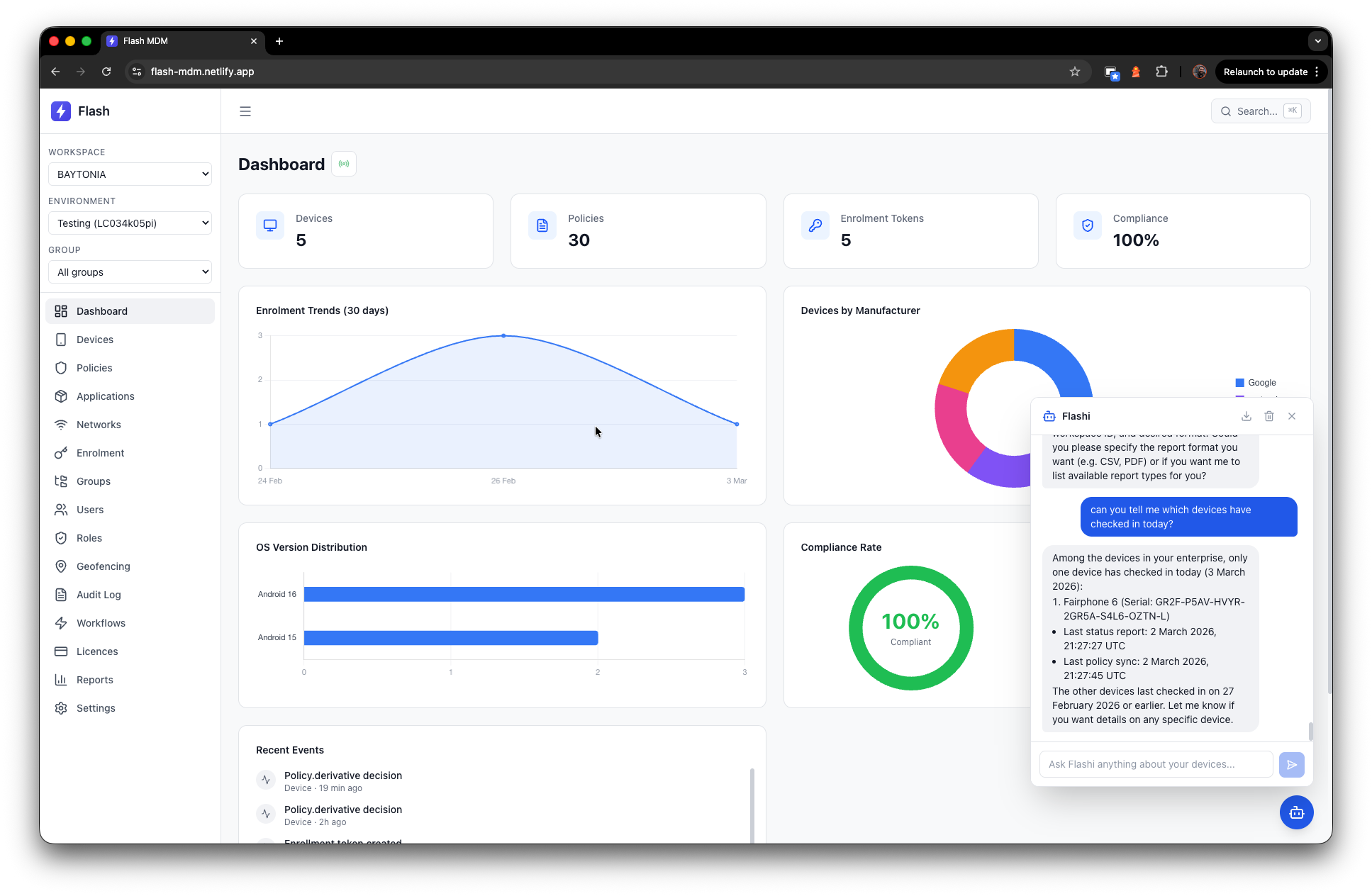
#The dashboard gives you an immediate read on your estate: device counts, policy counts, enrolment token status, compliance rates, OS version distribution, manufacturer breakdown, and enrolment trends over time. It's the landing page, and it tells you what you need to know without clicking through to anything else.
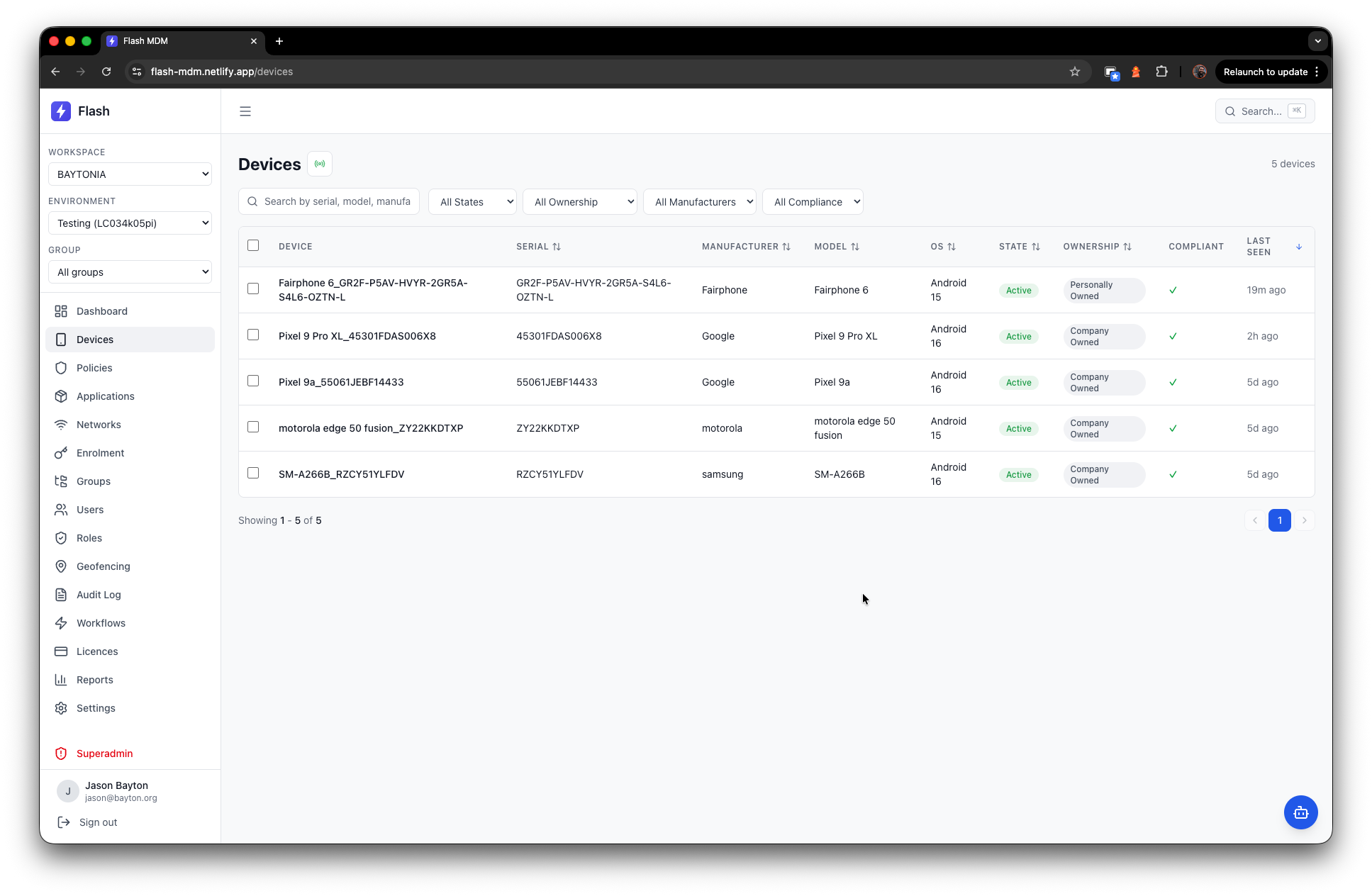
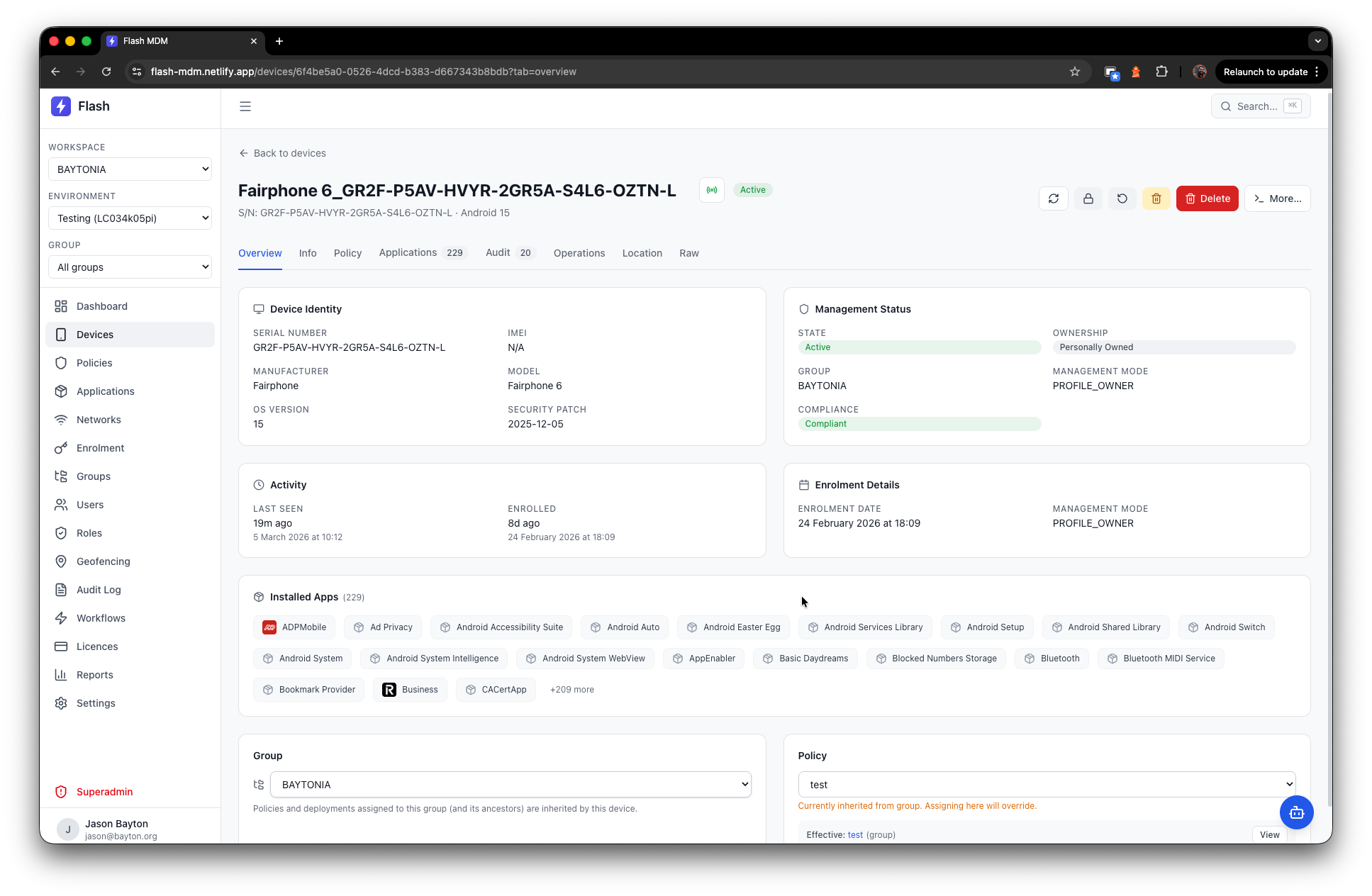
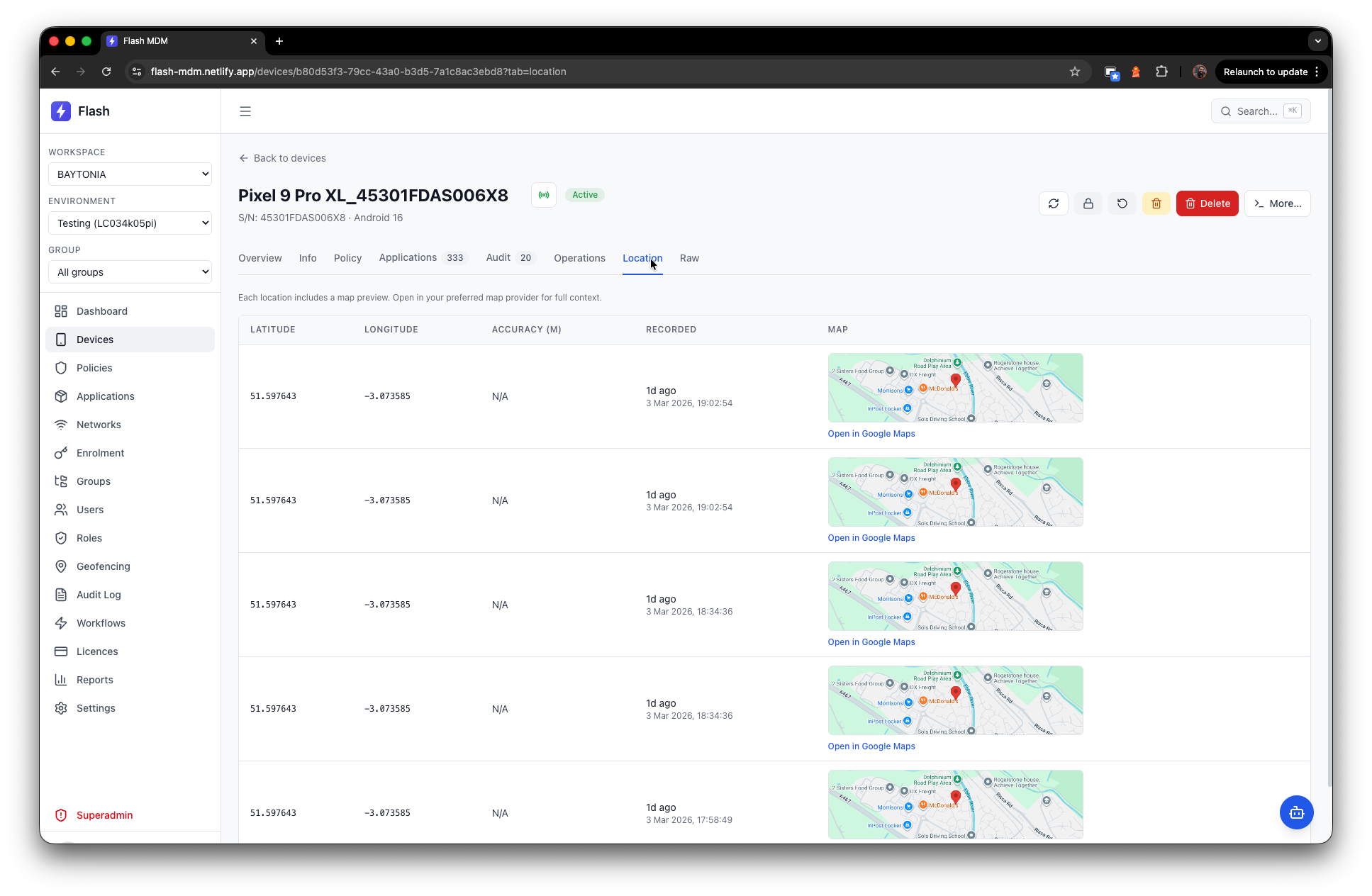
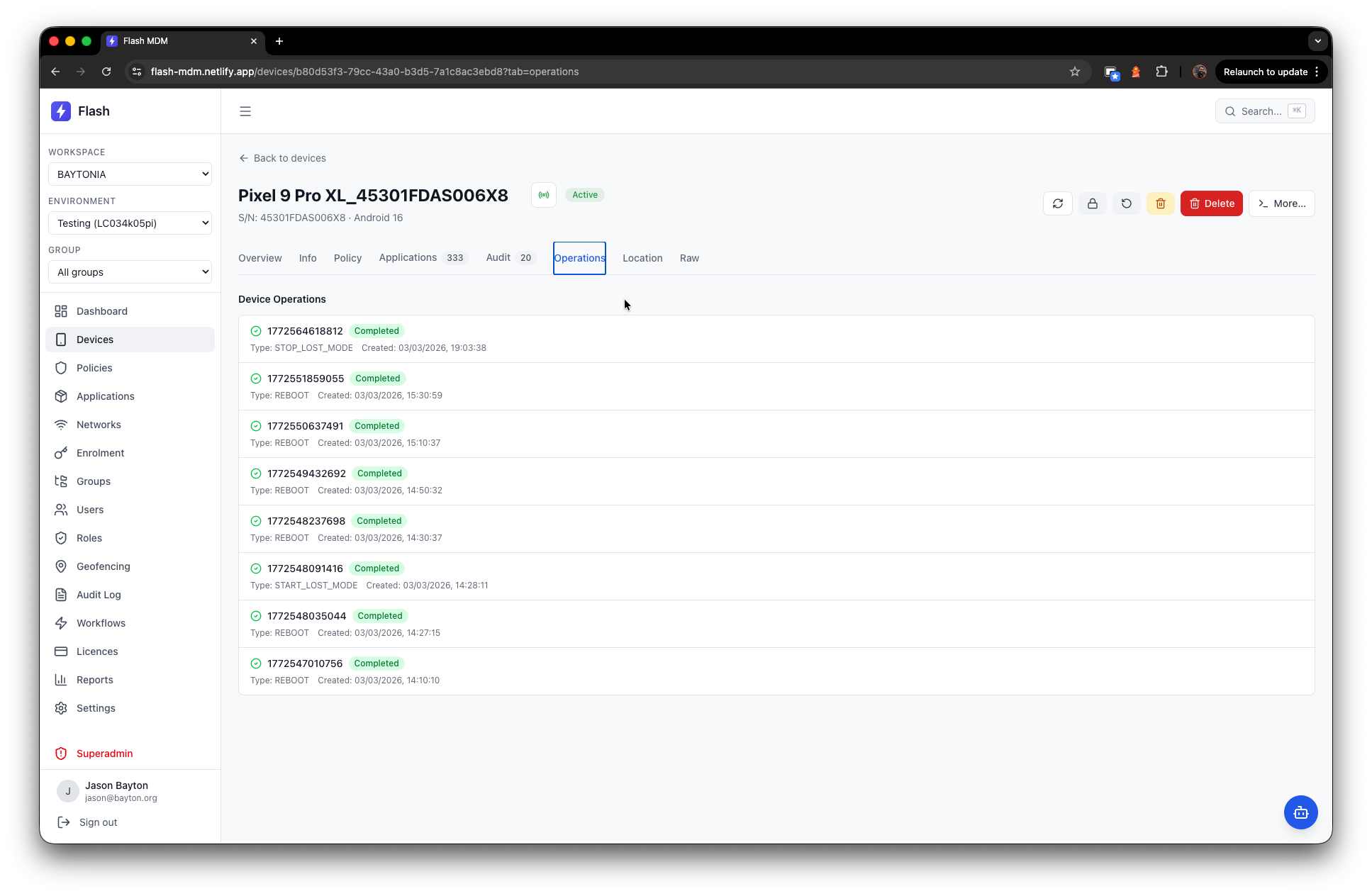
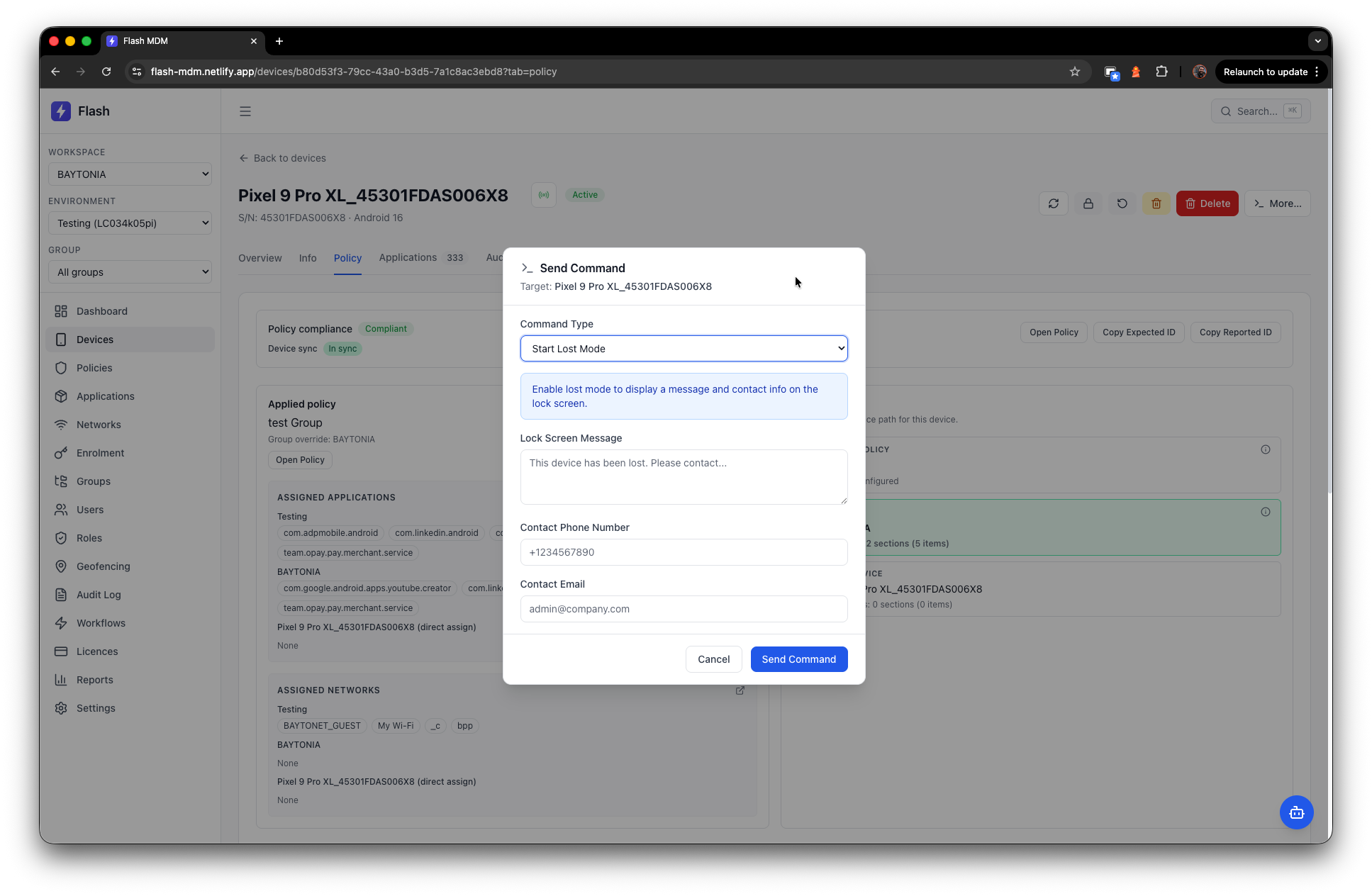
Device lifecycle covers the full journey. Enrolment token generation with QR codes, sign-in URL enrolment for BYOD, zero-touch provisioning configuration, real-time state synchronisation via Google Pub/Sub push notifications, background reconciliation jobs for eventual consistency, and device commands including lock, reboot, disable, and wipe. The device detail view breaks down into tabs for hardware identity, installed applications, policy compliance, audit history, operations log, and location tracking*.
*Location and geofencing require a companion app, TBD.
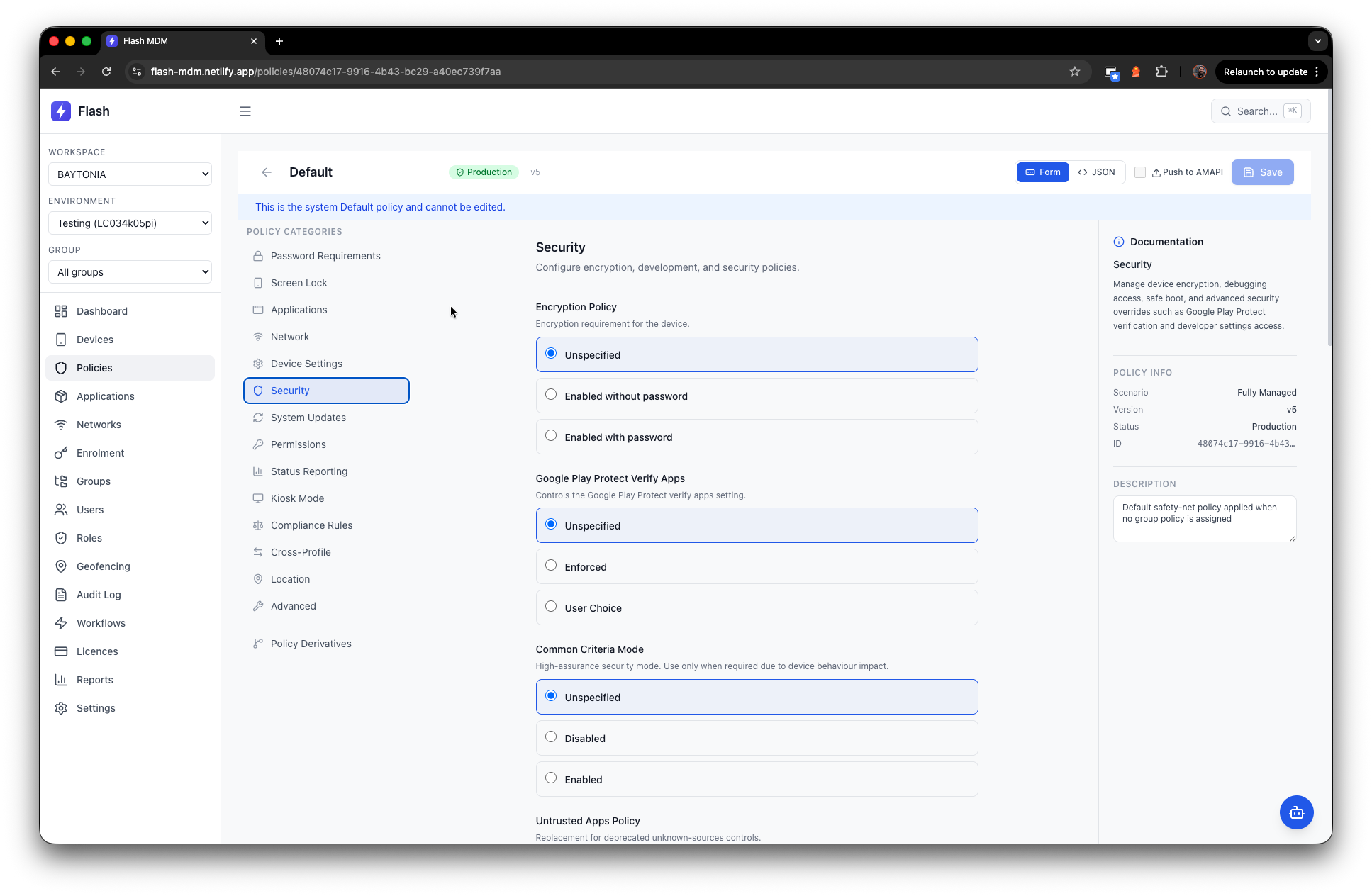
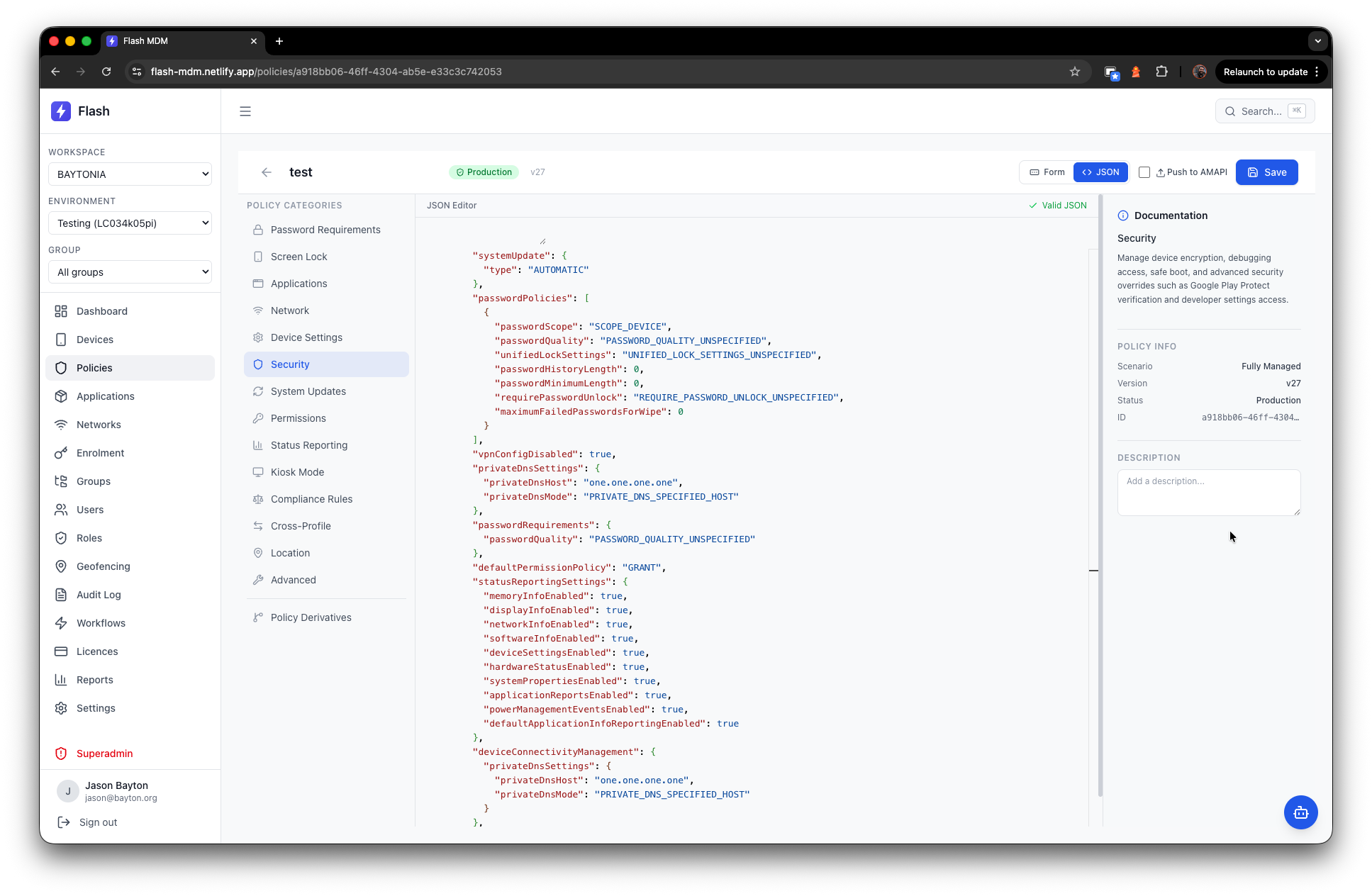
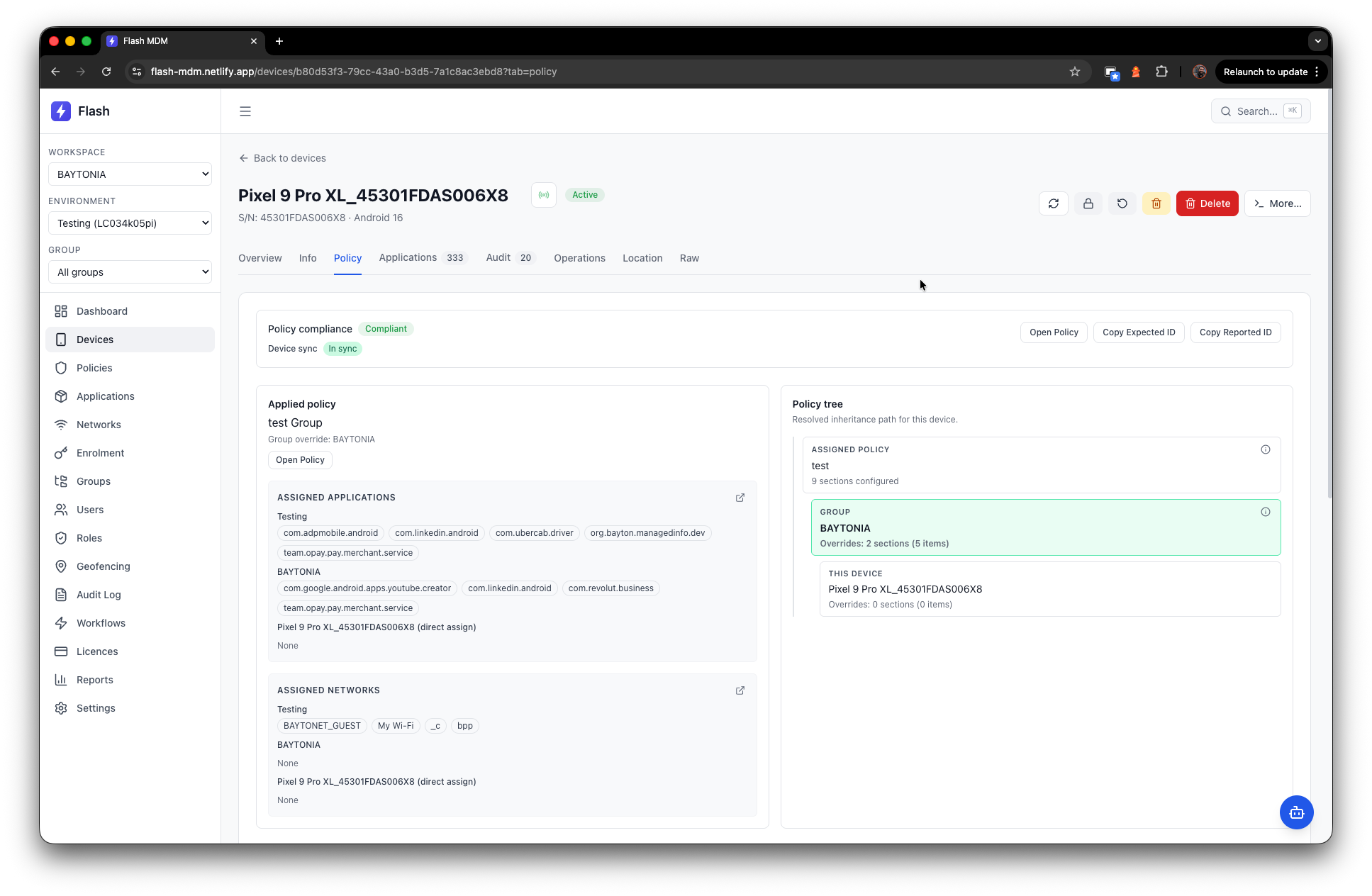
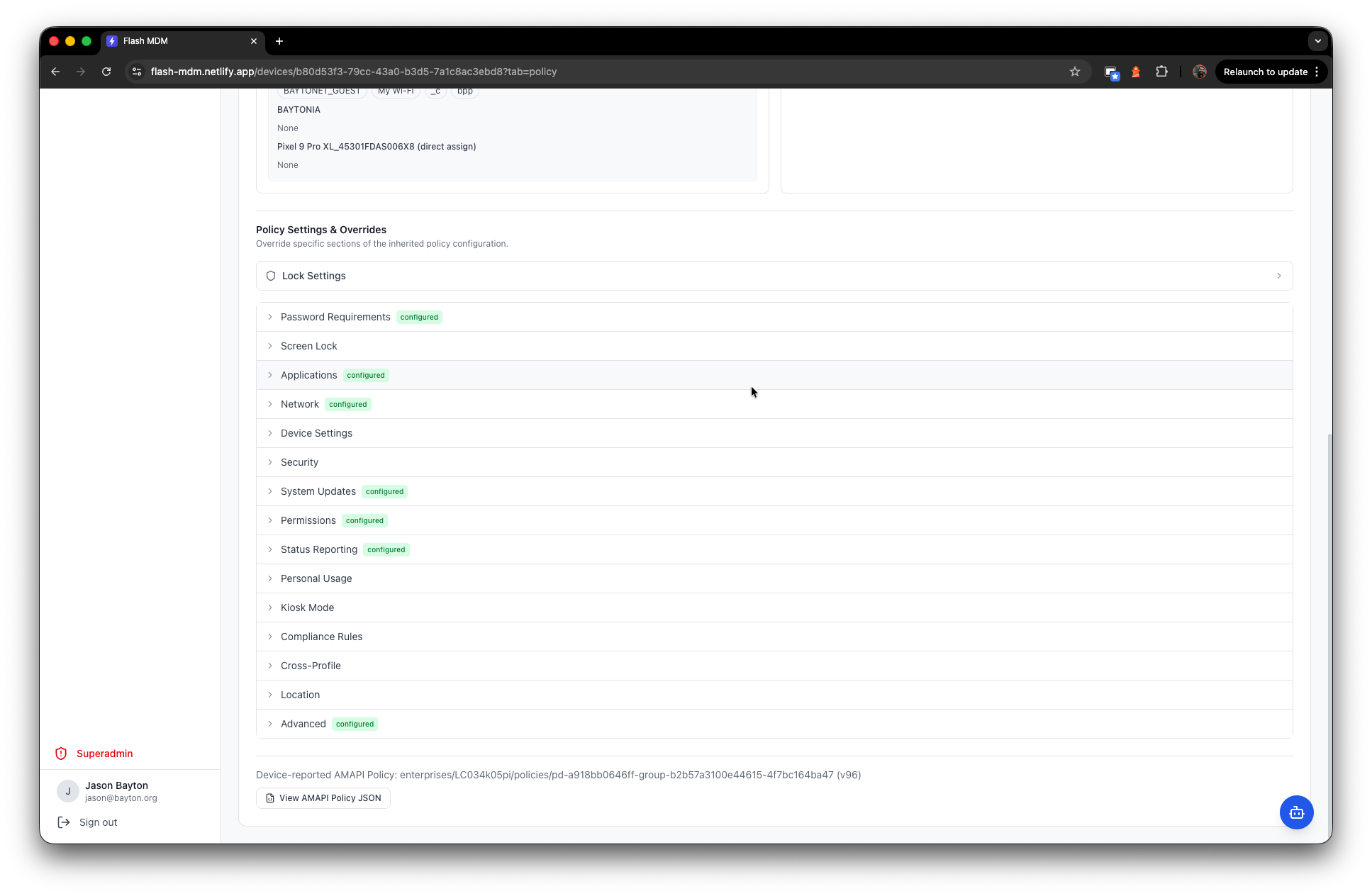
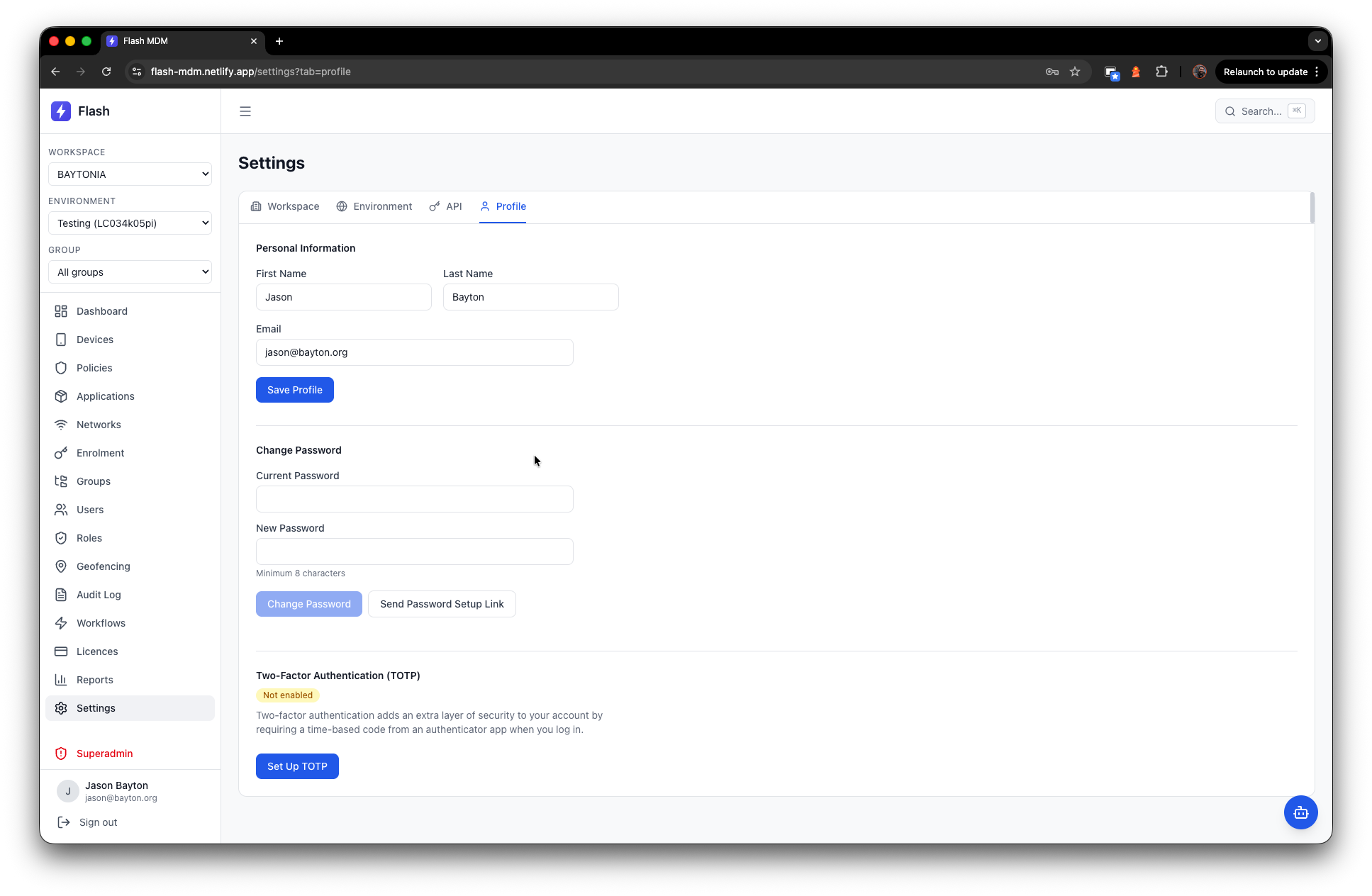
Policy management follows a waterfall inheritance model through the group hierarchy, with per-device overrides available when you need them. Applications and network configurations are componentised - define them once, assign them across the environment - while the core policy settings are managed per-policy with a structured form view covering everything from password requirements and restrictions through to kiosk mode and compliance rules. A Monaco-powered JSON editor is there for when you need full control over the raw policy.
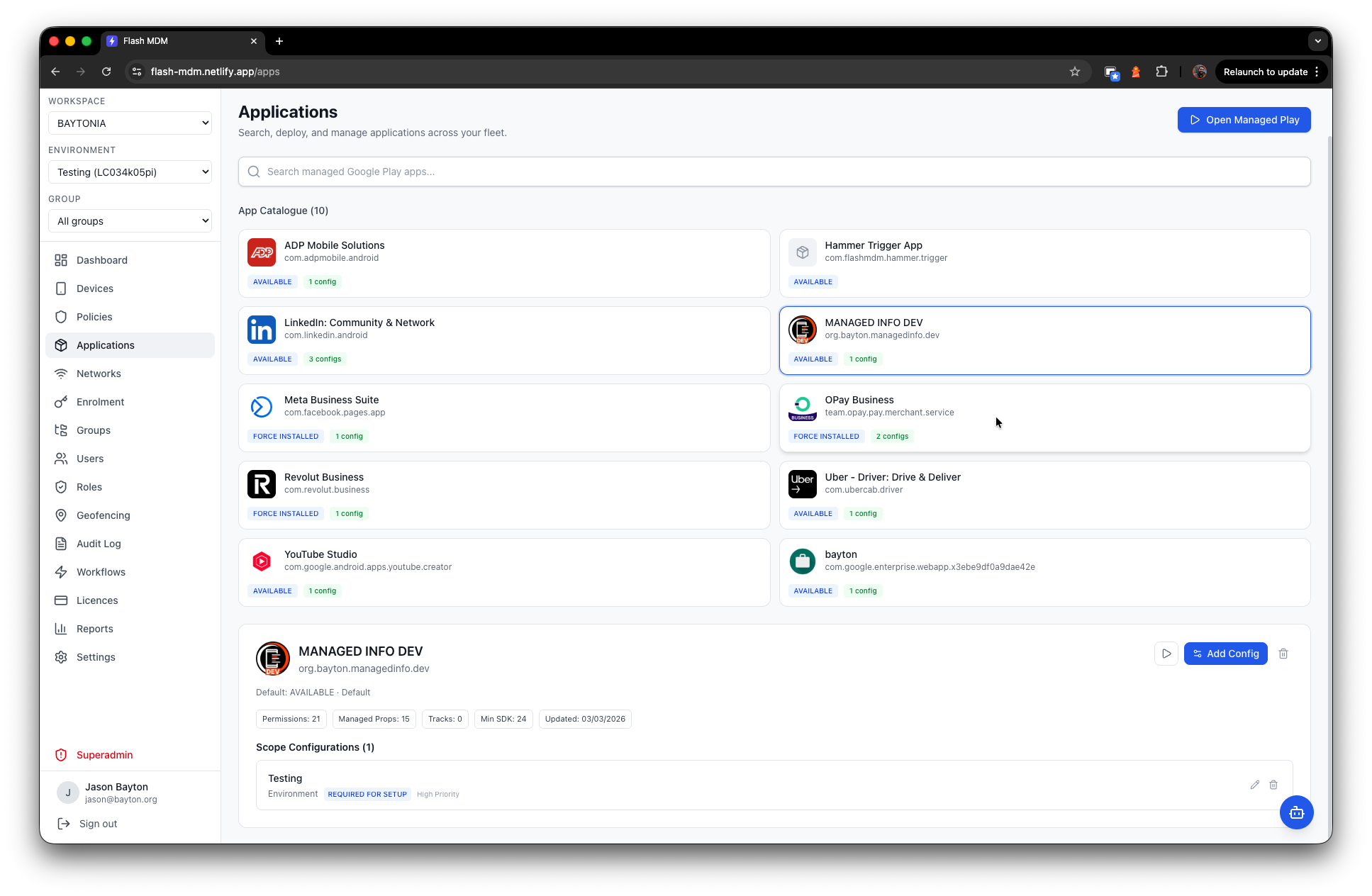
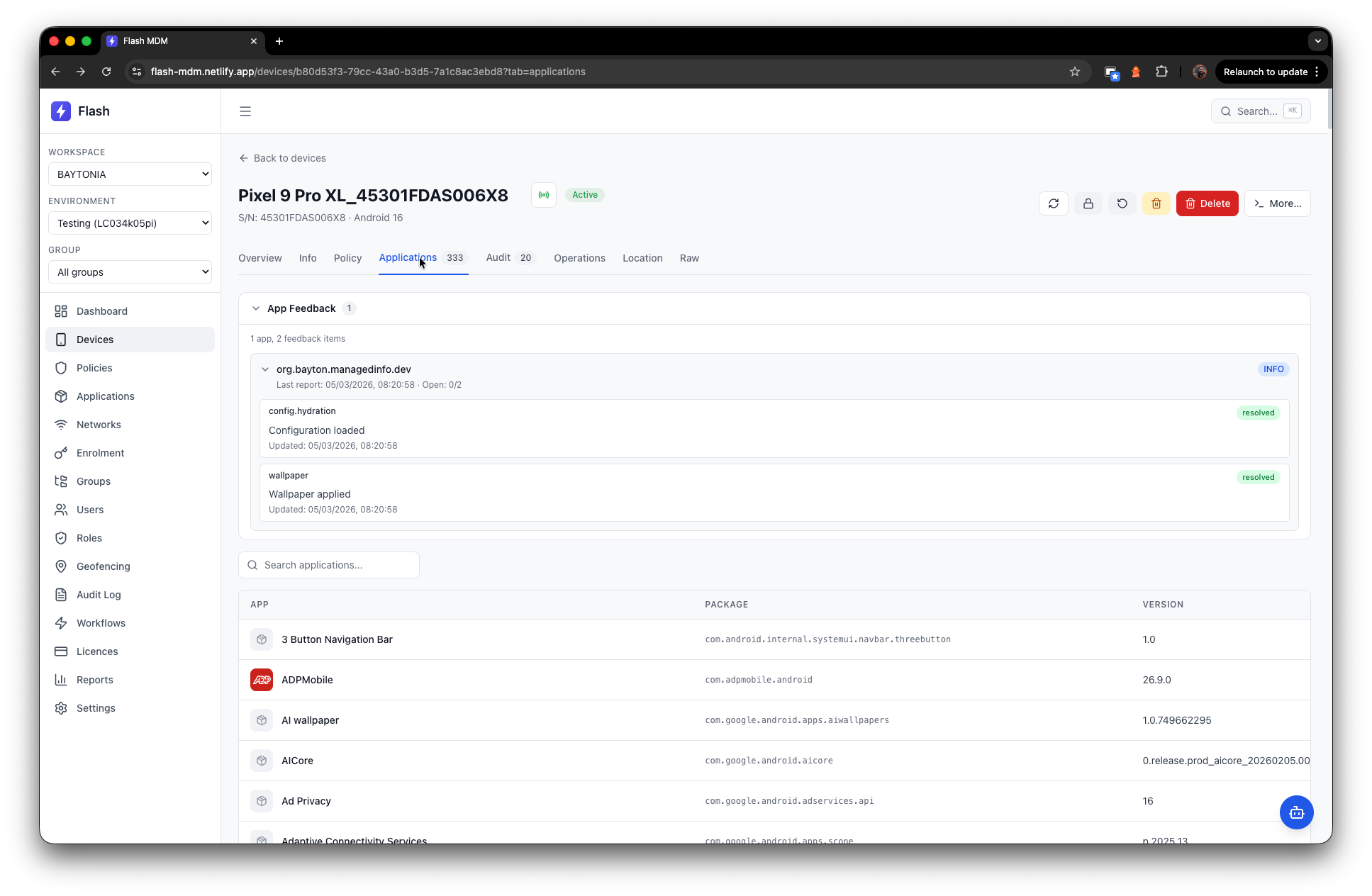
Application management integrates with managed Google Play for searching, deploying, and configuring applications across the estate. App feedback from devices surfaces directly in the console, and managed configurations let you push settings to supported applications.
Enrolment supports multiple provisioning methods: QR code, sign-in URL enrolment for BYOD scenarios with domain-restricted access, and zero-touch provisioning integration.. amongst others.
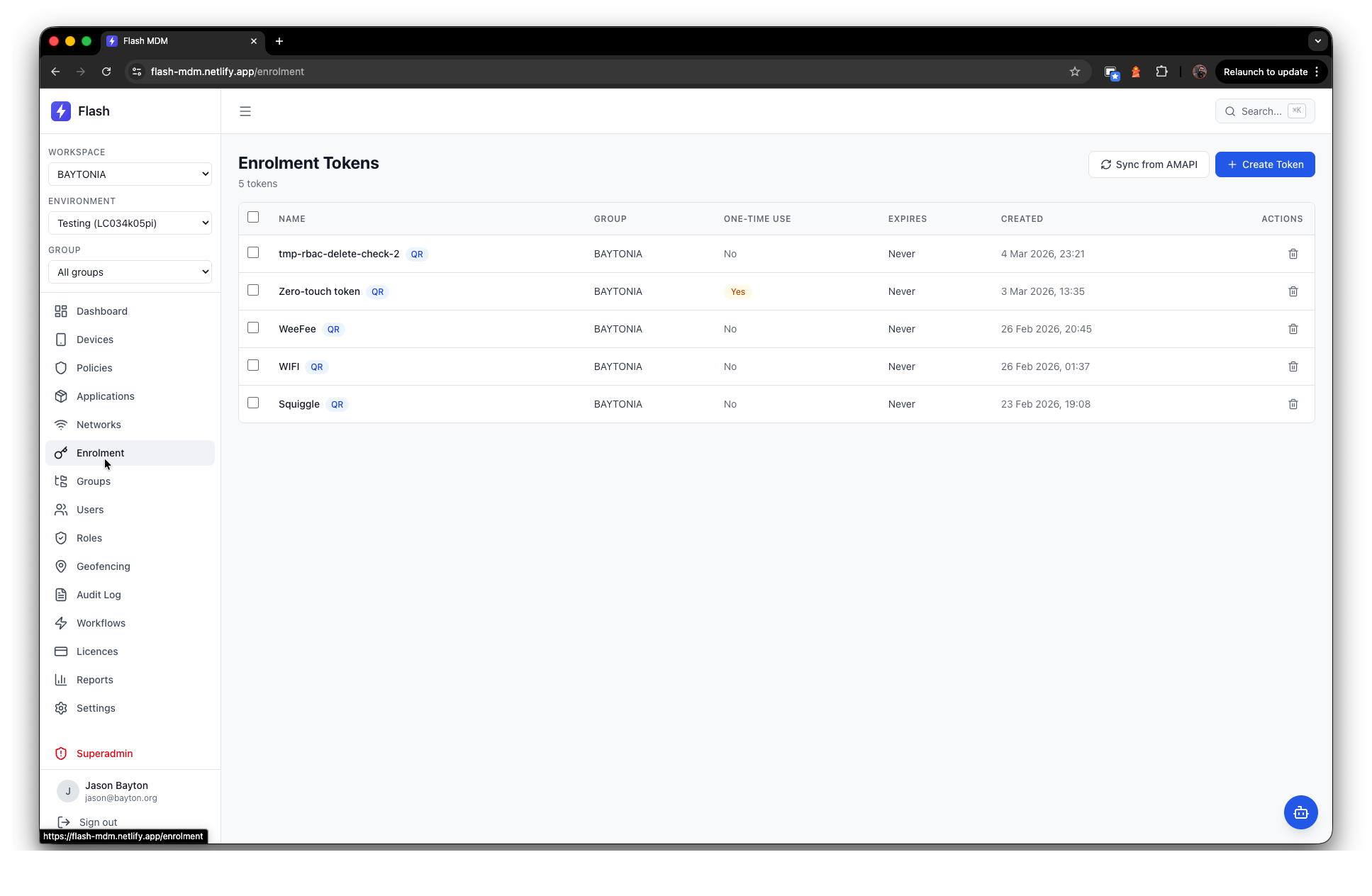
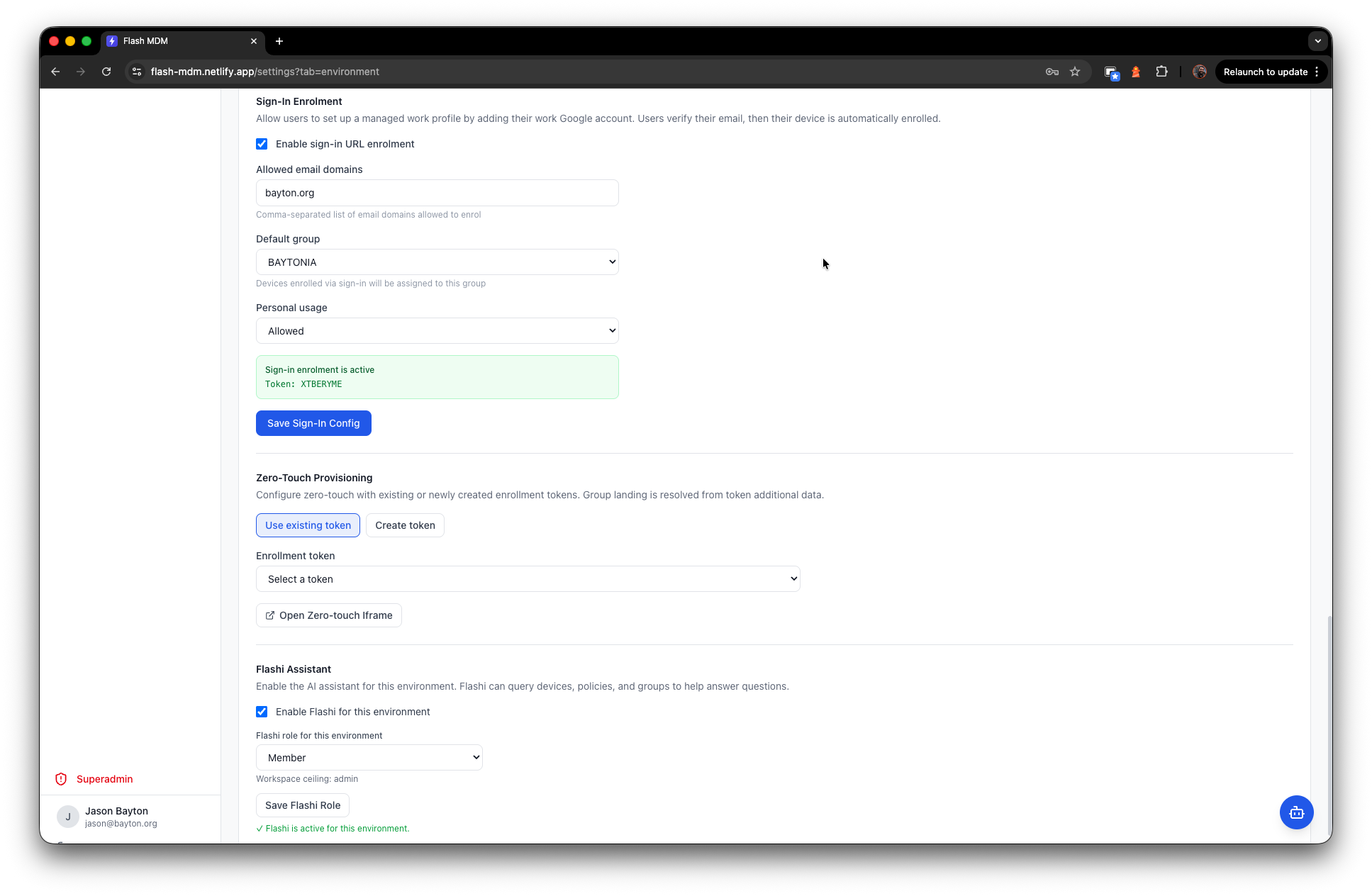
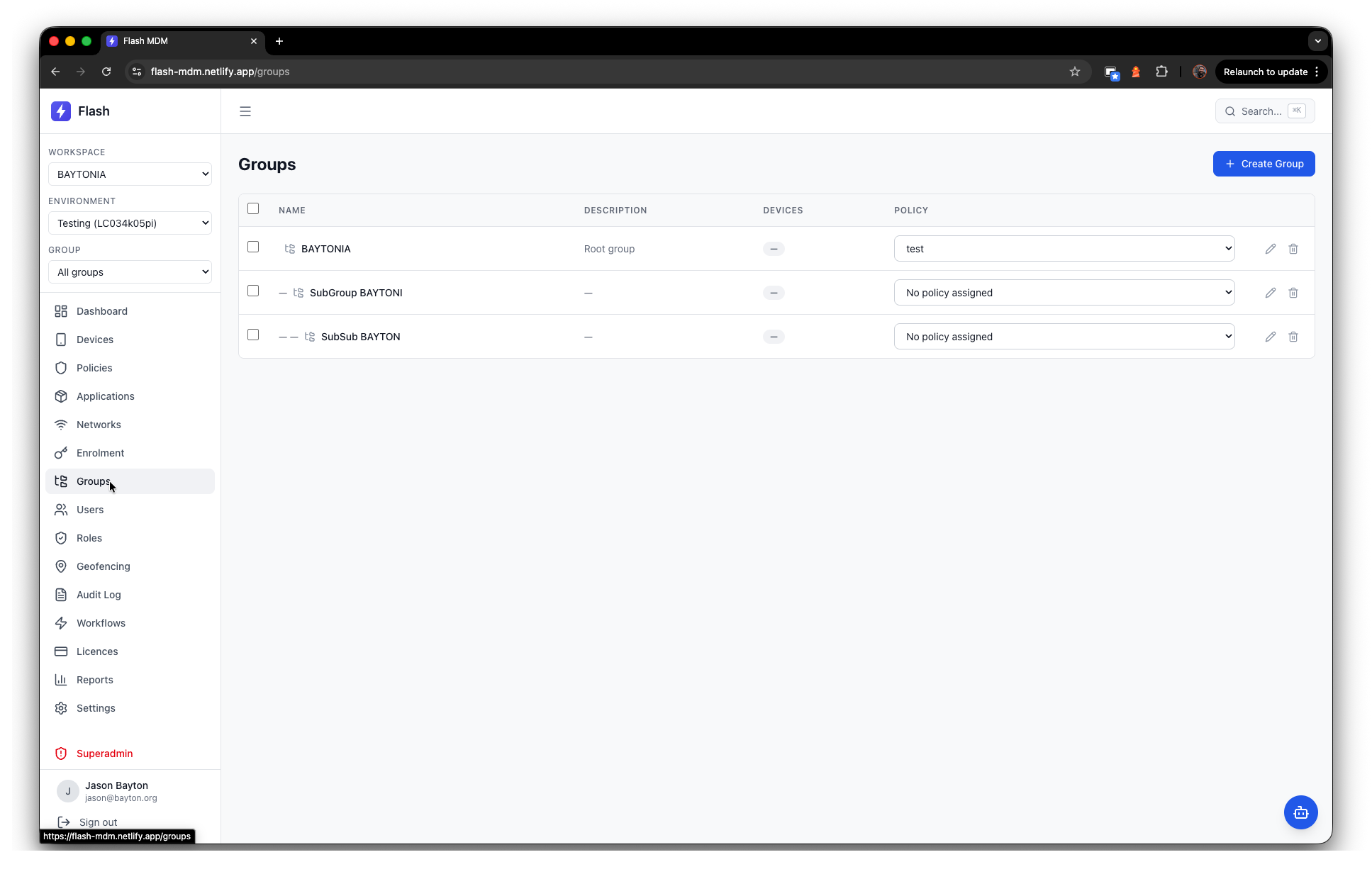
Groups provide hierarchical organisation with a closure table model, so you can nest groups as deep as you need and assign policies at any level.
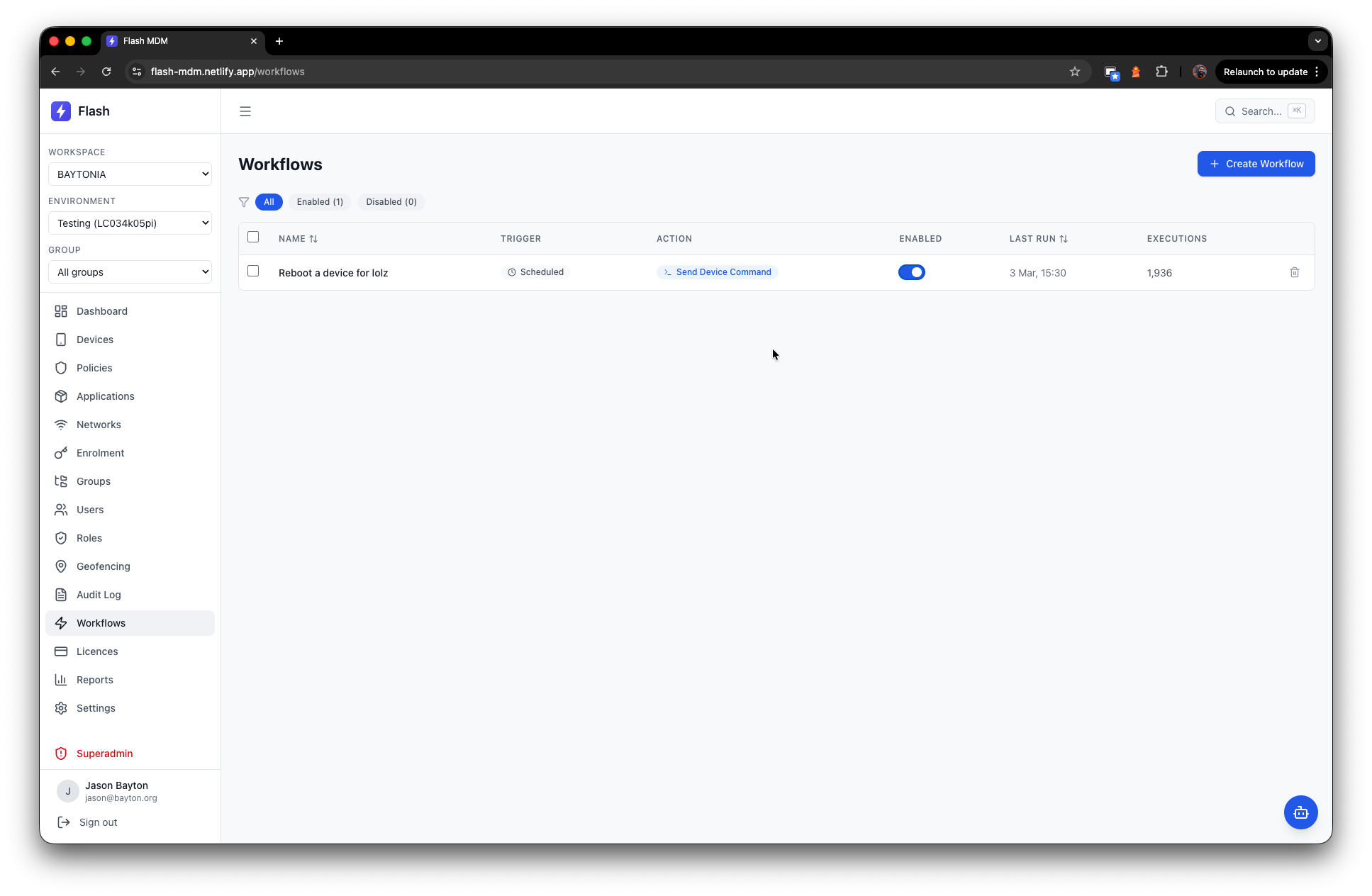
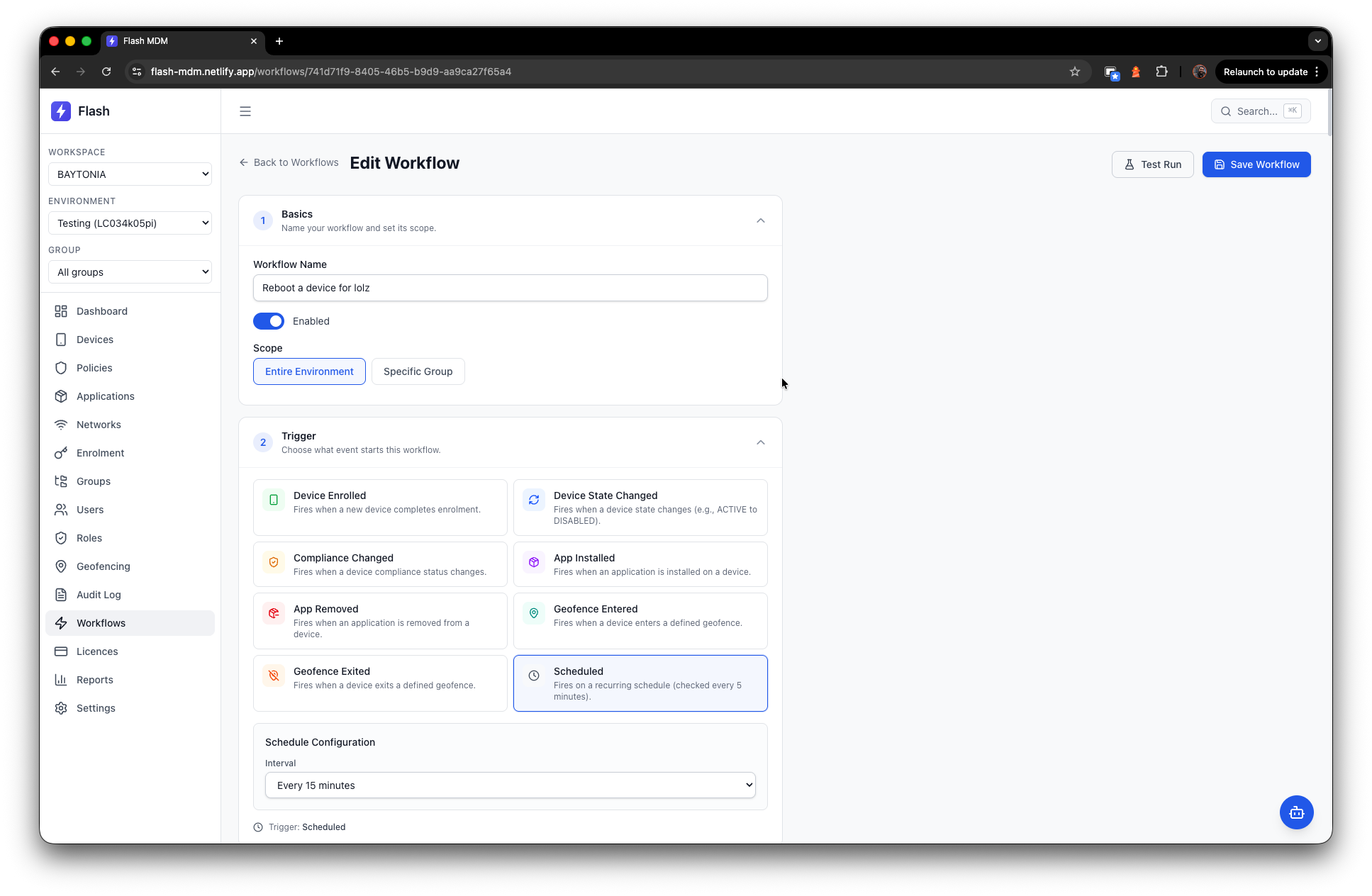
Workflows provide event-driven automation. Define triggers based on device enrolment, state changes, compliance violations, app installations, geofence events, or time-based schedules, and the platform evaluates them asynchronously through a background job queue. Think of it as a lightweight IFTTT for your device fleet.
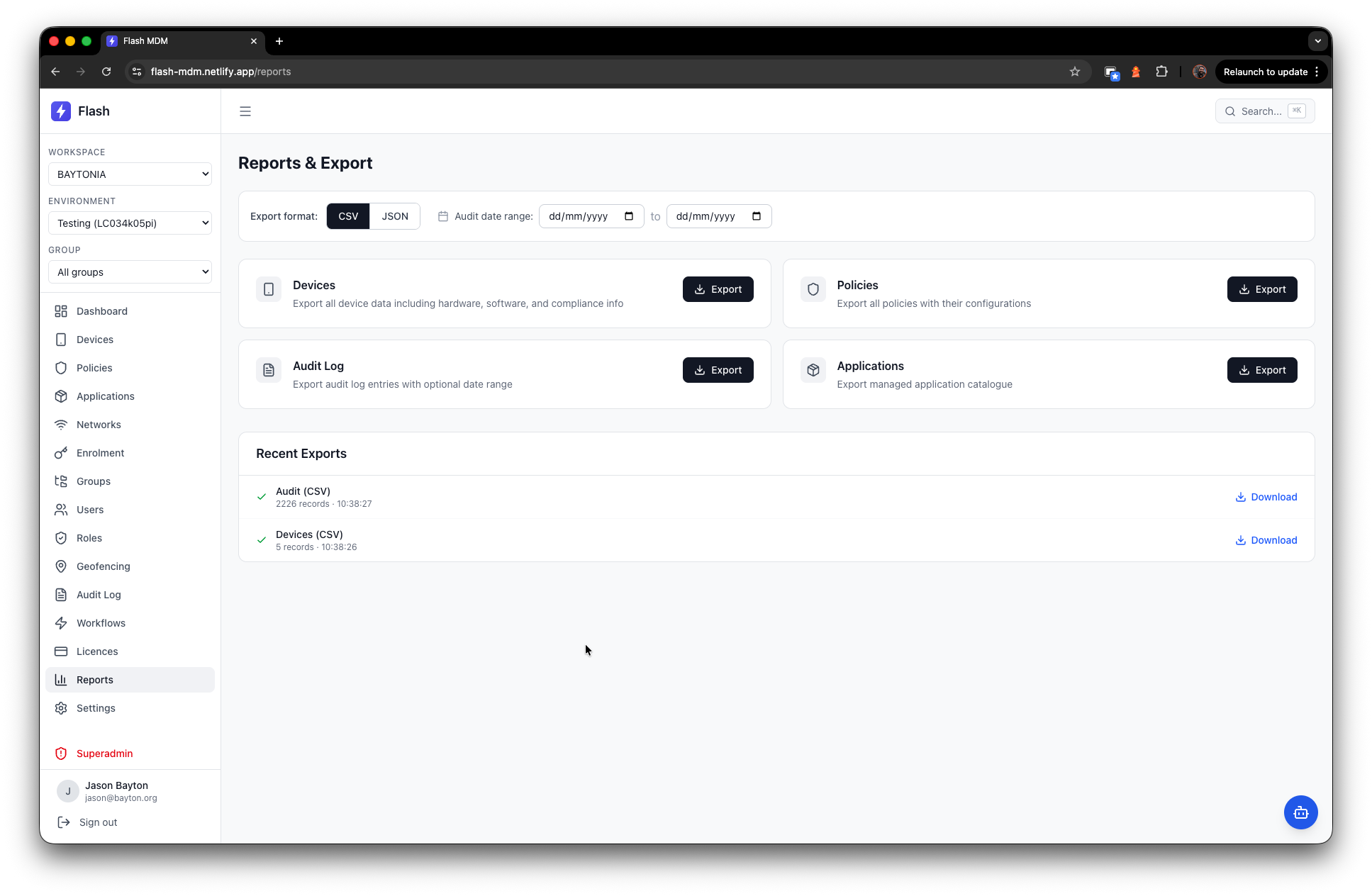
Reports and exports let you pull device inventories, policy configurations, audit logs, and application catalogues in CSV and JSON formats.
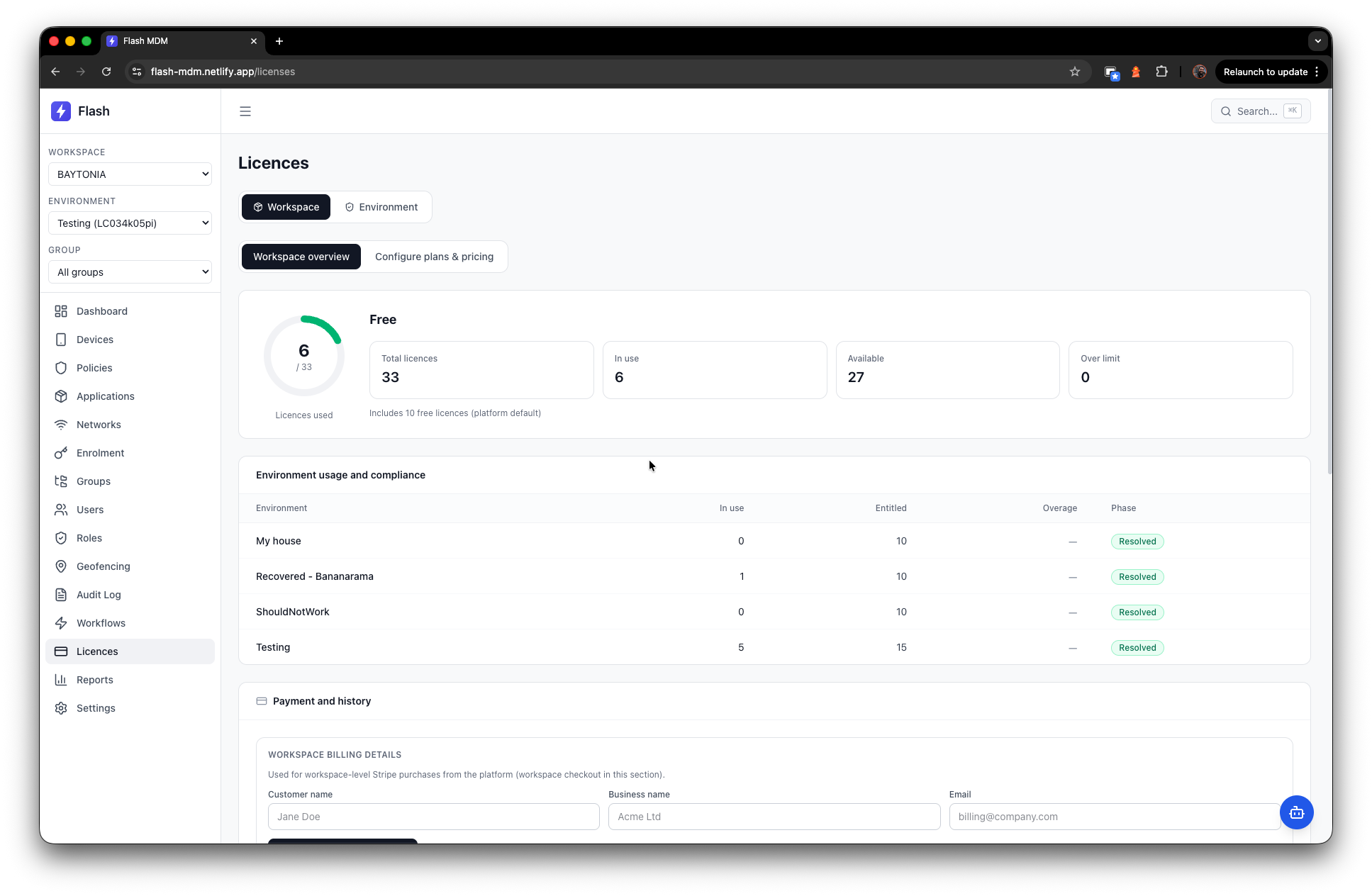
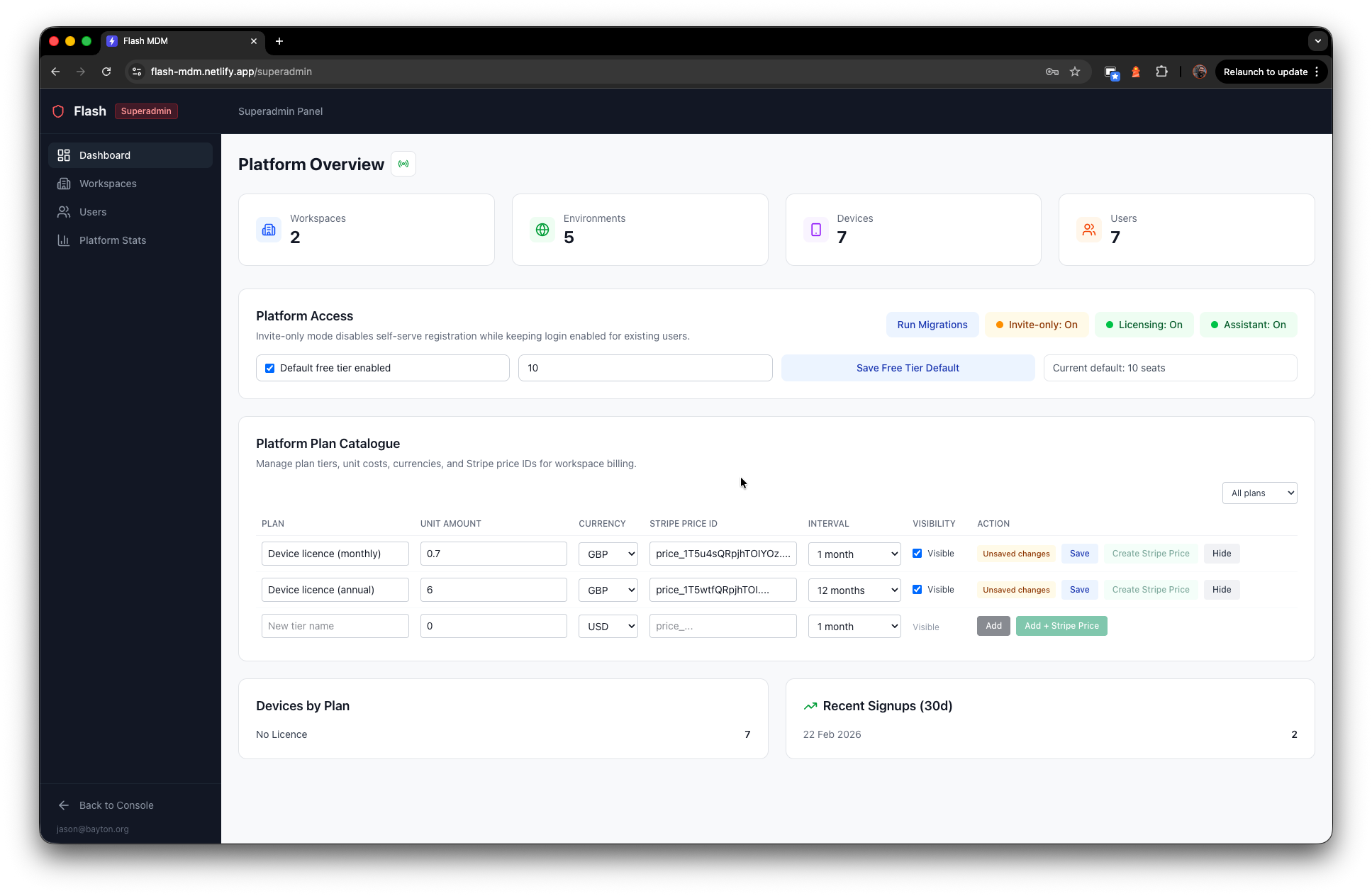
Licensing ties into Stripe for workspace-level billing, with plan management, device quotas, overage handling, and grace period enforcement.
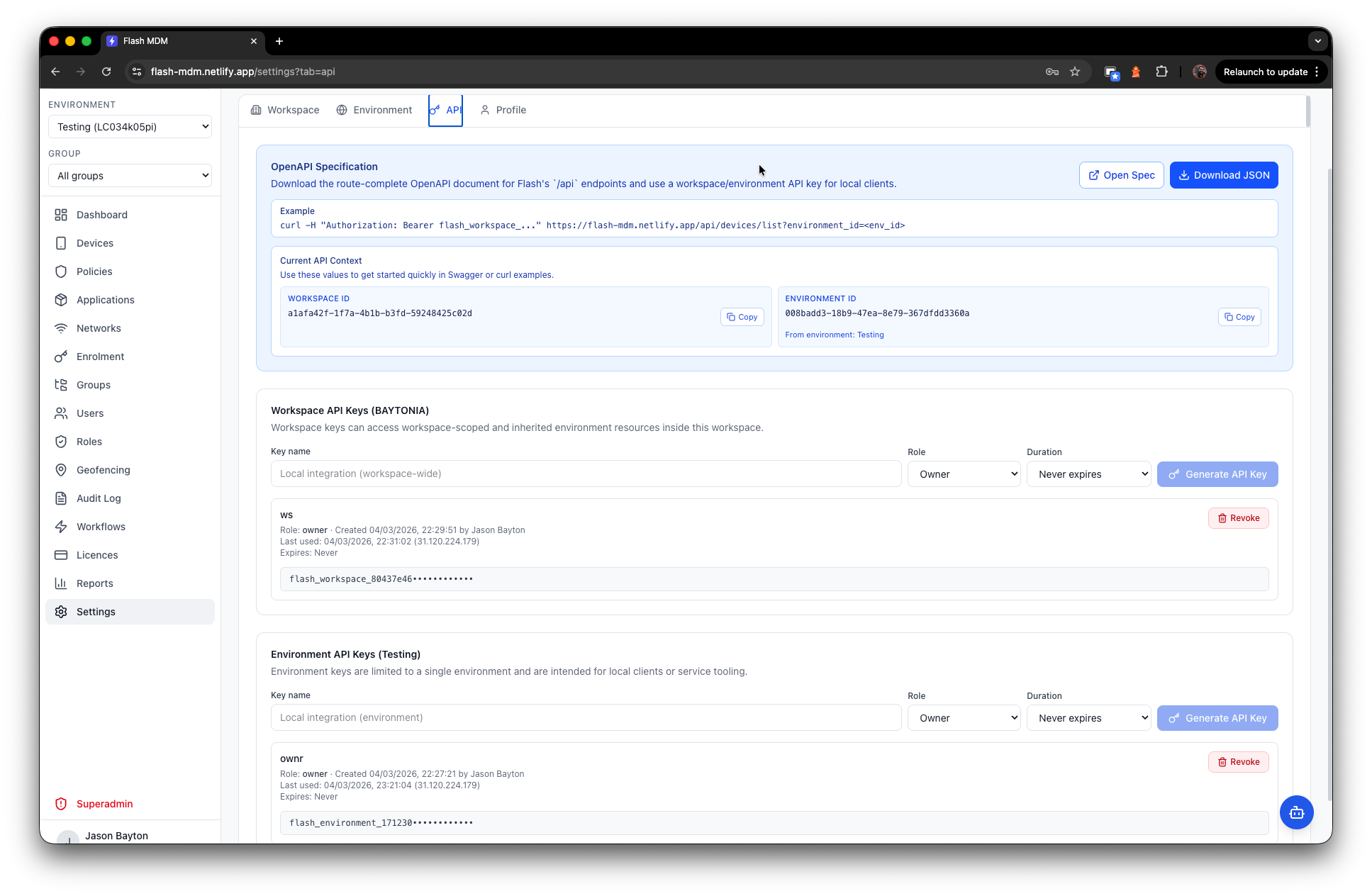
The API is comprehensive - over 80 serverless functions spanning auth, workspaces, environments, groups, devices, policies, components, apps, enrolment, certificates, workflows, geofences, licensing, billing, dashboard aggregation, audit logging, and superadmin operations. It ships with an OpenAPI specification and supports both workspace-scoped and environment-scoped API keys. Every endpoint is a potential integration point, whether you're connecting a traditional automation pipeline or letting an autonomous agent manage your fleet.
You can see it live here: https://flash-mdm.netlify.app/api/docs/
An integrated AI assistant - Flashi - lets users query workspace data conversationally, using OpenAI's tool-calling with read-only AMAPI MCP tools alongside Flash's internal Postgres tools. This is the Commander concept, transplanted directly into the management platform. It worked in Commander, it works identically here, and it means every operator has a natural language interface to their entire estate without leaving the console.
Importantly, Flashi runs on Flash's own API - no direct database manipulation, no hard-wired access. It's subject to the same RBAC controls as any other user. Administrators can set Flashi's role per environment from the settings page: it defaults to viewer, leaning on the AMAPI MCP for read-only estate queries, but can be elevated up to admin-level to create policies, wipe devices, generate reports, and more. I've kept it safe by default, but flexible - use it as much as you trust it. It's gated behind a dual toggle - platform-level and per-environment - so administrators retain full control over whether it's active at all.
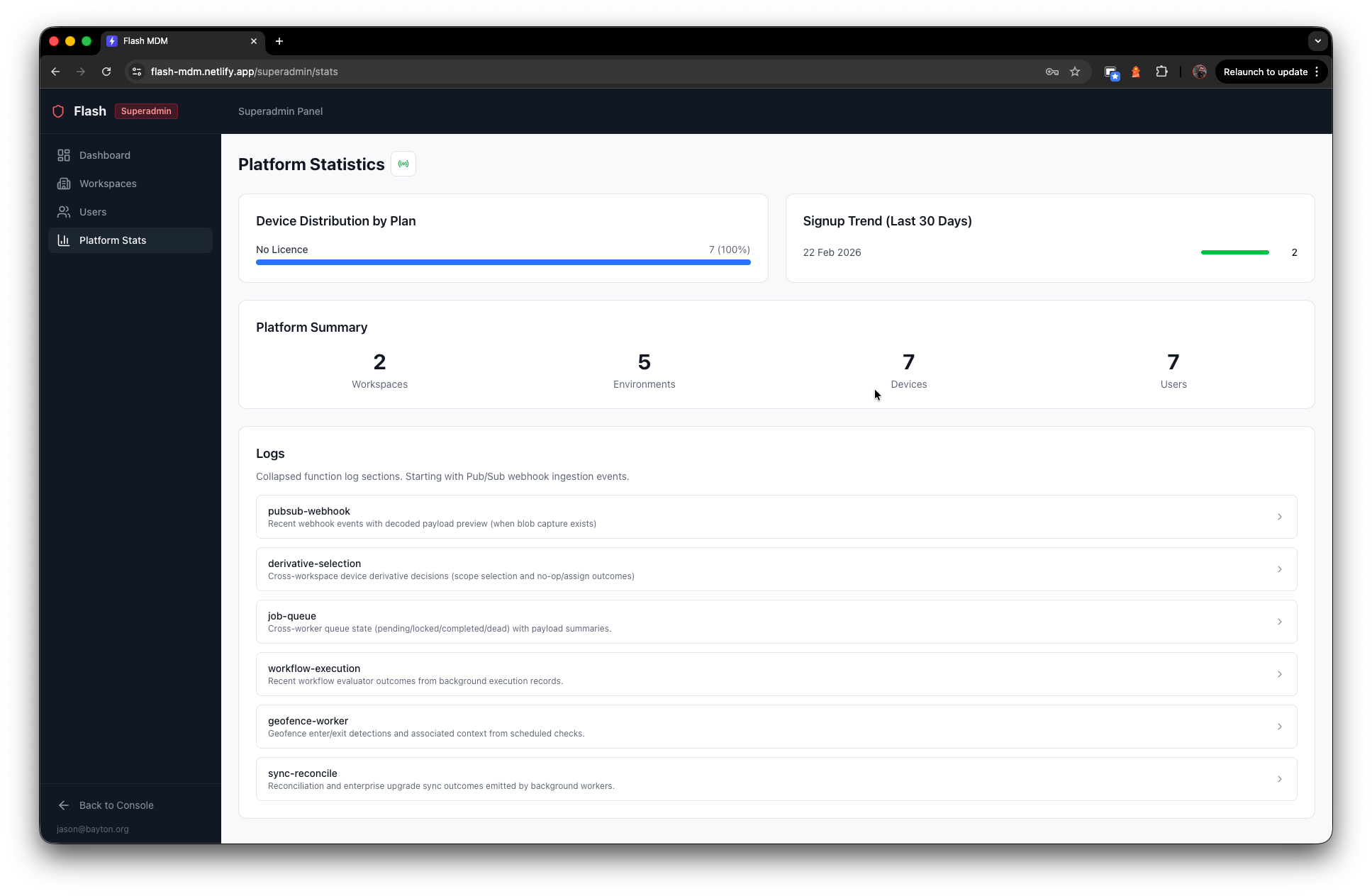
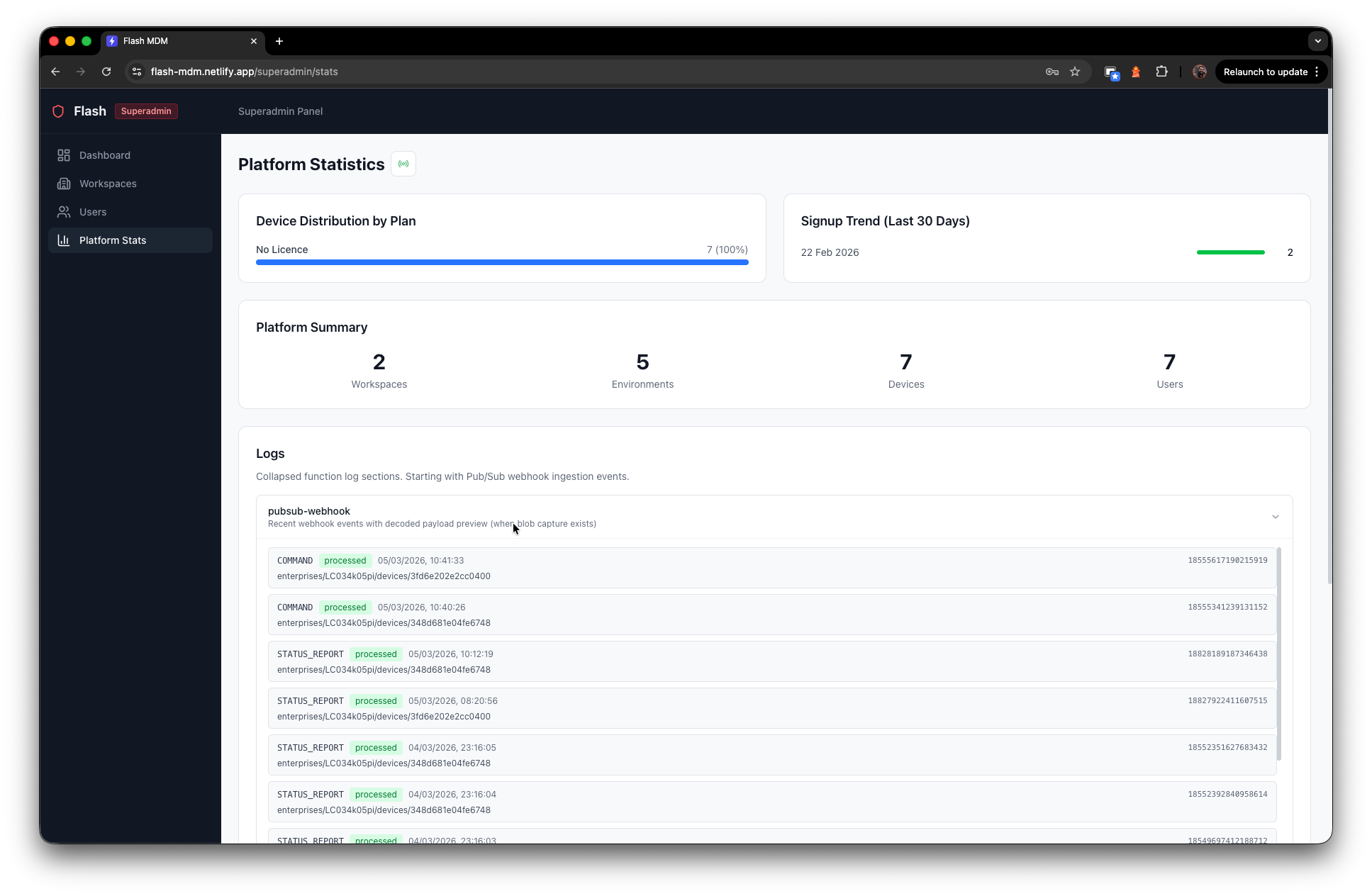
Multi-tenancy and RBAC are first-class. Four roles - owner, admin, member, viewer - enforced on every API call. Access can be workspace-wide or scoped to specific environments, so you can give a partner organisation visibility into their slice of the estate without exposing the rest. The superadmin panel provides platform-level oversight across all workspaces, environments, devices, and users.
Flash is a case study, not a product
#Flash MDM exists primarily as proof that this shift is real and happening now. It's a working, deployable platform with a comprehensive feature set and an architecture designed for extensibility.
In fact, if you have a spare Android device, you can take the platform for a spin by signing up below, just be mindful if you use the assistant it will run out of OpenAI API credits at some point:
https://flash-mdm.netlify.app/join/w/customer
Is it going to replace your enterprise MDM tomorrow? Probably not. Not next month, either. But the fact that it exists at all should give folks in this space something to think about.
This is an observation and a demonstration on where the barrier for entry now sits. The same APIs that power commercial MDM solutions are available to anyone with a Google Cloud project. The same frameworks, the same infrastructure, the same deployment platforms. What's changed is the velocity at which a single person - armed with domain expertise, an agentic workflow, and a decent laptop - can turn all of that into a working product.
Traditional MDM development, as we've known it for the last two decades, is dead. What comes next is going to be far more interesting.
Articles
2026
2025
- Google Play Protect is now the custom DPC gatekeeper, and everyone is a threat by default
- 12 deliveries of AE-mas (What shipped in Android Enterprise in 2025)
- The 12 AE requests of Christmas (2025 Edition)
- RCS Archival and you: clearing up the misconceptions
- Device Trust from Android Enterprise: What it is and how it works (hands-on)
- Android developer verification: what this means for consumers and enterprise
- AMAPI finally supports direct APK installation, this is how it works
- The Android Management API doesn't support pulling managed properties (config) from app tracks. Here's how to work around it
- Hands-on with CVE-2025-22442, a work profile sideloading vulnerability affecting most Android devices today
- AAB support for private apps in the managed Google Play iFrame is coming, take a first look here
- What's new (so far) for enterprise in Android 16
2024
- Android 15: What's new for enterprise?
- How Goto's acquisition of Miradore is eroding a once-promising MDM solution
- Google Play Protect no longer sends sideloaded applications for scanning on enterprise-managed devices
- Mobile Pros is moving to Discord
- Avoid another CrowdStrike takedown: Two approaches to replacing Windows
- Introducing MANAGED SETTINGS
- I'm joining NinjaOne
- Samsung announces Knox SDK restrictions for Android 15
- What's new (so far) for enterprise in Android 15
- Google quietly introduces new quotas for unvalidated AMAPI use
- What is Play Auto Install (PAI) in Android and how does it work?
- AMAPI publicly adds support for DPC migration
- How do Android devices become certified?
2023
- Mute @channel & @here notifications in Slack
- A guide to raising better support requests
- Ask Jason: How should we manage security and/or OS updates for our devices?
- Pixel 8 series launches with 7 years of software support
- Android's work profile behaviour has been reverted in 14 beta 5.3
- Fairphone raises the bar with commitment to Android updates
- Product files: The DoorDash T8
- Android's work profile gets a major upgrade in 14
- Google's inactive account policy may not impact Android Enterprise customers
- Product files: Alternative form factors and power solutions
- What's new in Android 14 for enterprise
- Introducing Micro Mobility
- Android Enterprise: A refresher
2022
- What I'd like to see from Android Enterprise in 2023
- Thoughts on Android 12's password complexity changes
- Google Play target API requirements & impact on enterprise applications
- Sunsetting Discuss comment platform
- Google publishes differences between Android and Android Go
- Android Go & EMM support
- Relaunching bayton.org
- AER dropped the 3/5 year update mandate with Android 11, where are we now?
- I made a bet with Google (and lost)
2020
- Product files: Building Android devices
- Google announce big changes to zero-touch
- VMware announces end of support for Device Admin
- Google launch the Android Enterprise Help Community
- Watch: An Android Enterprise discussion with Hypergate
- Listen again: BM podcast #144 - Jason Bayton & Russ Mohr talk Android!
- Google's Android Management API will soon support COPE
- Android Enterprise in 11: Google reduces visibility and control with COPE to bolster privacy.
- The decade that redefined Android in the enterprise
2019
- Why Intune doesn't support Android Enterprise COPE
- VMware WS1 UEM 1908 supports Android Enterprise enrolments on closed networks and AOSP devices
- The Bayton 2019 Android Enterprise experience survey
- Android Enterprise Partner Summit 2019 highlights
- The Huawei ban and Enterprise: what now?
- Dabbling with Android Enterprise in Q beta 3
- Why I moved from Google WiFi to Netgear Orbi
- I'm joining Social Mobile as Director of Android Innovation
- Android Enterprise in Q/10: features and clarity on DA deprecation
- MWC 2019: Mid-range devices excel, 5G everything, form-factors galore and Android Enterprise
- UEM tools managing Android-powered cars
- Joining the Android Enterprise Experts community
- February was an interesting month for OEMConfig
- Google launch Android Enterprise Recommended for Managed Service Providers
- Migrating from Windows 10 Mobile? Here's why you should consider Android
- AER expands: Android Enterprise Recommended for EMMs
- What I'd like to see from Android Enterprise in 2019
2018
- My top Android apps in 2018
- Year in review: 2018
- MobileIron Cloud R58 supports Android Enterprise fully managed devices with work profiles
- Hands on with the Huawei Mate 20 Pro
- Workspace ONE UEM 1810 introduces support for Android Enterprise fully managed devices with work profiles
- G Suite no longer prevents Android data leakage by default
- Live: Huawei Mate series launch
- How to sideload the Digital Wellbeing beta on Pie
- How to manually update the Nokia 7 Plus to Android Pie
- Hands on with the BQ Aquaris X2 Pro
- Hands on with Sony OEMConfig
- The state of Android Enterprise in 2018
- BYOD & Privacy: Don’t settle for legacy Android management in 2018
- Connecting two Synologies via SSH using public and private key authentication
- How to update Rsync on Mac OS Mojave and High Sierra
- Intune gains support for Android Enterprise COSU deployments
- Android Enterprise Recommended: HMD Global launch the Nokia 3.1 and Nokia 5.1
- Android Enterprise Partner Summit 2018 highlights
- Live: MobileIron LIVE! 2018
- Android Enterprise first: AirWatch 9.4 lands with a new name and focus
- Live: Android Enterprise Partner Summit 2018
- Samsung, Oreo and an inconsistent Android Enterprise UX
- MobileIron launch Android Enterprise work profiles on fully managed devices
- Android P demonstrates Google's focus on the enterprise
- An introduction to managed Google Play
- MWC 2018: Android One, Oreo Go, Android Enterprise Recommended & Android Enterprise
- Enterprise ready: Google launch Android Enterprise Recommended
2017
- Year in review: 2017
- Google is deprecating device admin in favour of Android Enterprise
- Hands on with the Sony Xperia XZ1 Compact
- Moto C Plus giveaway
- The state of Android Enterprise in 2017
- Samsung launched a Note 8 for enterprise
- MobileIron officially supports Android Enterprise QR code provisioning
- Android zero-touch enrolment has landed
- MobileIron unofficially supports QR provisioning for Android Enterprise work-managed devices, this is how I found it
- Hands on with the Nokia 3
- Experimenting with clustering and data replication in Nextcloud with MariaDB Galera and SyncThing
- Introducing documentation on bayton.org
- Goodbye Alexa, Hey Google: Hands on with the Google Home
- Restricting access to Exchange ActiveSync
- What is Mobile Device Management?
- 8 tips for a successful EMM deployment
- Long-term update: the fitlet-RM, a fanless industrial mini PC by Compulab
- First look: the FreedomPop V7
- Vault7 and the CIA: This is why we need EMM
- What is Android Enterprise (Android for Work) and why is it used?
- Introducing night mode on bayton.org
- What is iOS Supervision and why is it used?
- Hands on with the Galaxy TabPro S
- Introducing Nextcloud demo servers
- Part 4 - Project Obsidian: Obsidian is dead, long live Obsidian
2016
- My top Android apps 2016
- Hands on with the Linx 12V64
- Wandera review 2016: 2 years on
- Deploying MobileIron 9.1+ on KVM
- Hands on with the Nextcloud Box
- How a promoted tweet landed me on Finnish national news
- Using RWG Mobile for simple, cross-device centralised voicemail
- Part 3 – Project Obsidian: A change, data migration day 1 and build day 2
- Hands on: fitlet-RM, a fanless industrial mini PC by Compulab
- Part 2 - Project Obsidian: Build day 1
- Part 1 - Project Obsidian: Objectives & parts list
- Part 0 - Project Obsidian: Low power NAS & container server
- 5 Android apps improving my Chromebook experience
- First look: Android apps on ChromeOS
- Competition: Win 3 months of free VPS/Container hosting - Closed!
- ElasticHosts review
- ElasticHosts: Cloud Storage vs Folders, what's the difference?
- Adding bash completion to LXD
- Android N: First look & hands-on
- Springs.io - Container hosting at container prices
- Apple vs the FBI: This is why we need MDM
- Miradore Online MDM: Expanding management with subscriptions
- Lenovo Yoga 300 (11IBY) hard drive upgrade
- I bought a Lenovo Yoga 300, this is why I'm sending it back
- Restricting access to Exchange ActiveSync
- Switching to HTTPS on WordPress
2015
2014
- Is CYOD the answer to the BYOD headache?
- BYOD Management: Yes, we can wipe your phone
- A fortnight with Android Wear: LG G Watch review
- First look: Miradore Online free MDM
- Hands on: A weekend with Google Glass
- A month with Wandera Mobile Gateway
- Final thoughts: Dell Venue Pro 11 (Atom)
- Thoughts on BYOD
- Will 2014 bring better battery life?
- My year in review: Bayton.org
- The best purchase I've ever made? A Moto G for my father
2013
2012
- My Top Android Apps 12/12
- The Nexus 7 saga: Resolved
- Recycling Caps Lock into something useful - Ubuntu (12.04)
- The Nexus 7 saga continues
- From Wows to Woes: Why I won't be recommending a Nexus7 any time soon.
- Nexus7: What you need to know
- Why I disabled dlvr.it links on Facebook
- HTC Sense: Changing the lockscreen icons from within ADW
2011
- Push your Google+ posts to Twitter and Facebook
- Using multiple accounts with Google.
- The "Wn-R48" (Windows on the Cr-48)
- Want a Google+ invite?
- Publishing to external sources from Google+
- Dell Streak review. The Phone/Tablet Hybrid
- BlueInput: The Bluetooth HID driver Google forgot to include
- Pushing Buzz to Twitter with dlvr.it
- Managing your social outreach with dlvr.it
- When Awe met Some. The Cr-48 and Gnome3.
- Living with Google's Cr-48 and the cloud.
- Downtime 23-25/04/2011
- Are you practising "safe surfing"?
- The Virtualbox bug: "Cannot access the kernel driver" in Windows
- Putting tech into perspective
2010
- Have a Google Buzz Christmas
- Root a G1 running Android 1.6 without recovery!
- Windows 7 display issues on old Dell desktops
- Google added the Apps flexibility we've been waiting for!
- Part I: My 3 step program for moving to Google Apps
- Downloading torrents
- Completing the Buzz experience for Google Maps Mobile
- Quicktip: Trial Google Apps
- Quicktip: Save internet images fast
- Turn your desktop 3D!
- Part III - Device not compatible - Skype on 3
- Swype not compatible? ShapeWriter!
- Don't wait, get Swype now!
- HideIP VPN. Finally!
- Google enables Wave for Apps domains
- Aspire One touch screen
- Streamline XP into Ubuntu
- Edit a PDF with Zamzar
- Google offering Gmail addresses in the UK
- Google Wave: Revolutionising blogs!
- Hexxeh's Google Chrome OS builds
- Update: Buzz on Windows Mobile
- Alternatives to Internet Explorer
- Wordress 3.0 is coming!
- Skype for WM alternatives
- Browsing on a (data) budget? Opera!
- Buzz on unsupported mobiles
- Buzz on your desktop
- What's all the Buzz?
- Part II: Device not compatible - Skype on 3
- Part I - Device not compatible - Skype on 3
- Dreamscene on Windows 7
- Free Skype with 3? There's a catch..